
Why is it sometimes so difficult to say no?
Through the archetype of Lilith, mythology, depth psychology and astrology shed light on those inner moments when staying true to ourselves becomes more important than preserving harmony with others.
These turning points do not always appear as dramatic life decisions. More often, they arise in ordinary moments of everyday life, situations that seem almost insignificant at first.
The phone vibrates. A message notification appears.
She reads it and immediately feels a subtle tension. Six months have passed since she last heard from this person — a childhood friend with whom she still maintains contact, perhaps out of habit, perhaps out of loyalty. But something has shifted.
She pauses and wonders: does it still make sense to maintain a relationship that consists of two phone calls a year?
Deep down, she already knows the answer. Her need for genuine depth in relationships has become stronger. She no longer wants to pretend to listen, to respond politely, to send heart emojis that ring hollow, and then wait another six months before reaching out again out of a vague sense of obligation.
Now a part of her refuses to continue in the same way.
A quiet part, yet an unwavering one.
She takes a deep breath and writes:
“Thank you, but I’m not available at the moment. I wish you a lovely day.”
The message is sent. Her breath expands, as if something in her solar plexus has opened and given her space again. Almost immediately, however, the mind begins its familiar questioning.
Was I too harsh?
She might take it badly.
They’ll think I’m antisocial again.
Deep down, she knows she is aligned with her choice. For the first time in a long while, she has simply said no — out of respect for herself.
At first glance, this kind of situation may seem trivial. A message sent, a boundary expressed, a refusal spoken calmly. In reality, it often touches something far deeper than it appears.
Saying no is never a neutral gesture. Behind this small word lie years of relational habits, silent loyalties, fears of disappointing others or losing their affection. Sometimes this decision awakens an inner voice that immediately questions us, wondering whether we have been too harsh, too abrupt, or simply too much ourselves.
At certain moments in life, however, something becomes impossible to ignore — a quiet but persistent inner knowing that continuing as before would mean drifting further away from who we truly are.
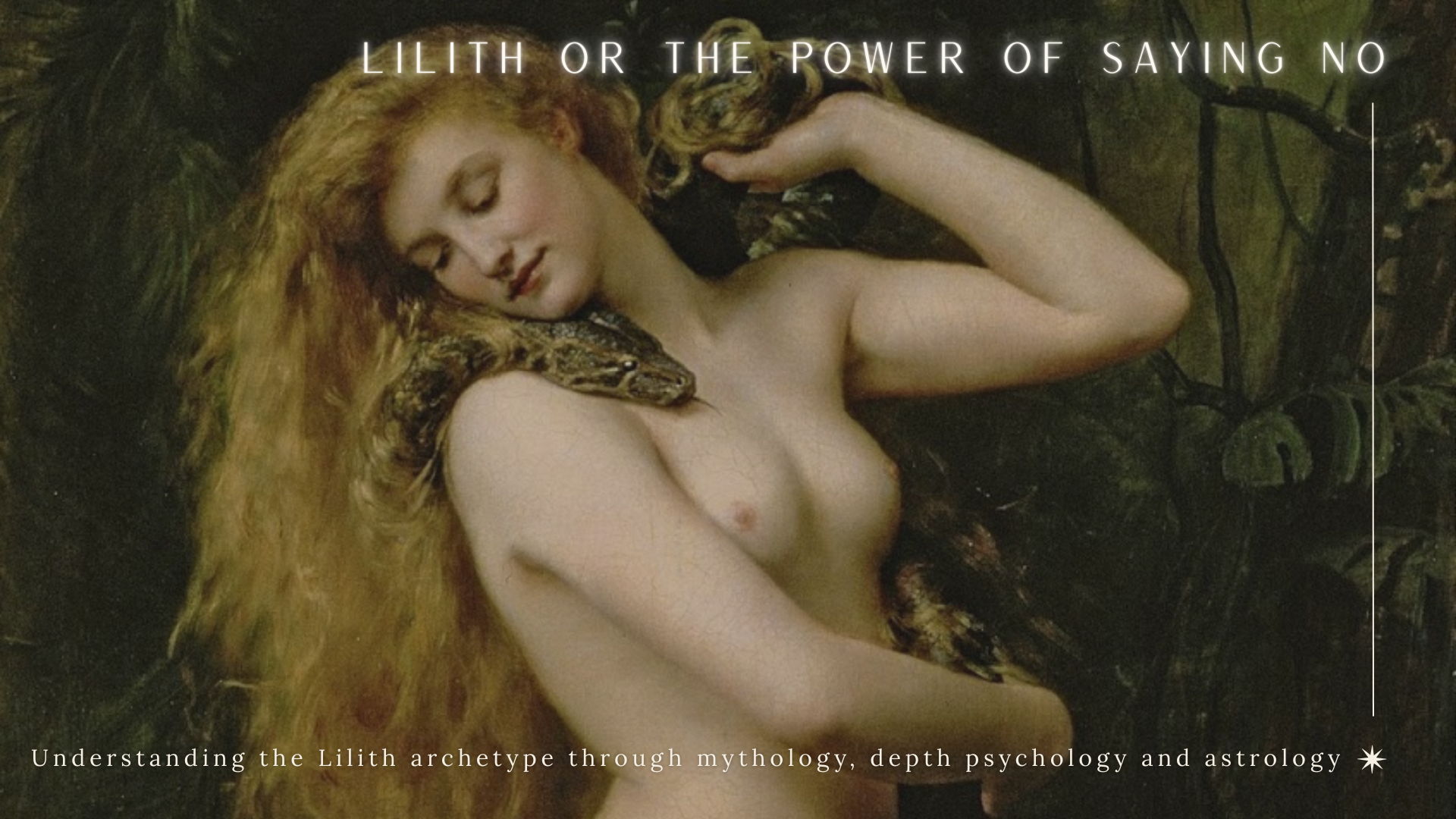
In mythology as well as in symbolic psychology, this inner force has an ancient name: Lilith.
Long before she was portrayed as a demonic or scandalous figure, Lilith appears in certain traditions as Adam’s first wife. Created from the same earth as he was, she refuses to submit and claims a relationship of equality. When this equality is denied, she chooses to leave the Garden of Eden rather than renounce what she senses as her deepest truth.
Over the centuries, this refusal was gradually transformed into transgression and then into fault. Lilith became associated with all the fears that feminine autonomy could provoke. She was depicted as a sorceress, a demon, a dangerous seductress — the embodiment of everything unsettling about a woman who refuses submission.
Behind these cultural projections, however, lies a powerful symbol: a part of the psyche that refuses to betray itself in order to preserve the established order.
If saying no can be so difficult, it is not only because we fear disappointing others. Beneath this decision often lie much deeper fears: the fear of being rejected, the fear of no longer being loved, and sometimes — in a quieter way — the fear of no longer existing in the eyes of another.
Human beings are profoundly relational. From early childhood, love and belonging are associated with safety and survival. Learning to adapt and respond to the expectations of those around us is part of the normal development of personality.
But there comes a moment when this adaptation becomes too costly. Continuing to meet the expectations of others begins to feel like a betrayal of one’s own truth.
It is precisely at this point that the symbolic energy of Lilith emerges: an inner force that urges us to remain faithful to ourselves, even if that means risking rejection or misunderstanding.
In myth, Lilith’s departure is often portrayed as a fault. Yet it can also be understood differently. Lilith does not flee — she chooses. She refuses a relationship that denies her equality and prefers to leave the garden rather than abandon what she senses as her dignity.
This decision has a price. It involves solitude, exile and the accusing gaze of those who remain within the established order. But it also marks the moment when a consciousness stops waiting for permission to exist.
In astrology, this symbolic energy is also called Lilith, or Black Moon Lilith. Unlike the planets, Lilith is not a visible celestial body. It corresponds to a particular point in the Moon’s orbit — an invisible focus that is not occupied by any planet.
This astronomical image is strikingly meaningful on a symbolic level. Lilith represents a kind of inner void around which something organizes itself — a point of tension within the psyche that is often difficult to integrate into the familiar structures of personality.
In a birth chart, the position of Lilith often reveals a place where the individual feels a strong demand for authenticity. It is a place where compromise becomes difficult, sometimes even impossible, because it creates the feeling of betraying oneself.
This energy may bring experiences of rejection, misunderstanding or marginality. At the same time, it can become a profound source of insight and inner freedom once a person accepts that they can no longer define themselves solely through the gaze of others.
Ultimately, Lilith’s energy does not first transform our relationships. It transforms the relationship we have with ourselves.
When this inner force begins to emerge, something subtly shifts within consciousness. What once seemed impossible — setting a boundary, saying no, refusing a situation that does not respect us — gradually becomes conceivable.
Not because the opinion of others suddenly stops mattering, but because another loyalty appears: a loyalty to oneself that runs deeper than the need for approval.
From that moment on, relationships inevitably change. Some adjust, others transform, and sometimes certain connections fade away. These movements are no longer experienced as tragic ruptures; they become the natural consequences of a more authentic inner position.
In myth, Lilith leaves the Garden of Eden rather than renounce her equality. In everyday life, this gesture often takes a much quieter form: a refusal expressed calmly, a boundary spoken simply, a decision that may appear ordinary but in reality marks a profound inner turning point.
Perhaps this is the true lesson of Lilith: learning to inhabit one’s own truth, even when that truth disrupts the established order.
Sometimes it begins with a single word.
No.
This text opens a series devoted to the great feminine archetypes present in mythology, psychology and astrology. Each of these figures — Lilith, Persephone, Ceres, Vesta and others — illuminates in its own way the moments of transformation we experience throughout life.
In the coming articles, we will explore these archetypes and the ways they can help us better understand certain stages of our inner journey.
In a birth chart reading, the position of Lilith often reveals a place of tension but also of inner power — a place where authenticity becomes essential and where compromise may no longer be possible.
If you would like to explore this dimension within your own birth chart, I offer individual astrology consultations.
I never knew Lilith this way. It extraordinary to think that her story became synonymous with devilishness and I for one am ready to reclaim that narrative. Thank you so much for sharing and I look forward to reading more.
Thank you for taking the time to read and share your thoughts. 🙏🏻
Lilith has often been reduced to a caricature of “dark femininity”, but her story also speaks about dignity, autonomy and the courage to remain true to oneself.
I’m glad the article resonated with you, and more reflections on these archetypes will follow.