
Lately, I’ve been noticing how central the question of security has become in our lives. Not only on a material or economic level, although those dimensions are obviously part of the picture. Something deeper seems to be touched. As though many people are sensing, often without fully being able to name it, that the structures they once relied on no longer provide the same sense of inner stability they once did.
What strikes me most is that this insecurity does not always come from a clearly identifiable external event. Sometimes it emerges even when, outwardly, everything still appears to be holding together. It can feel more like a subtle internal shift — the sensation of having reached the limits of a certain way of functioning, thinking, protecting ourselves, or inhabiting reality itself.
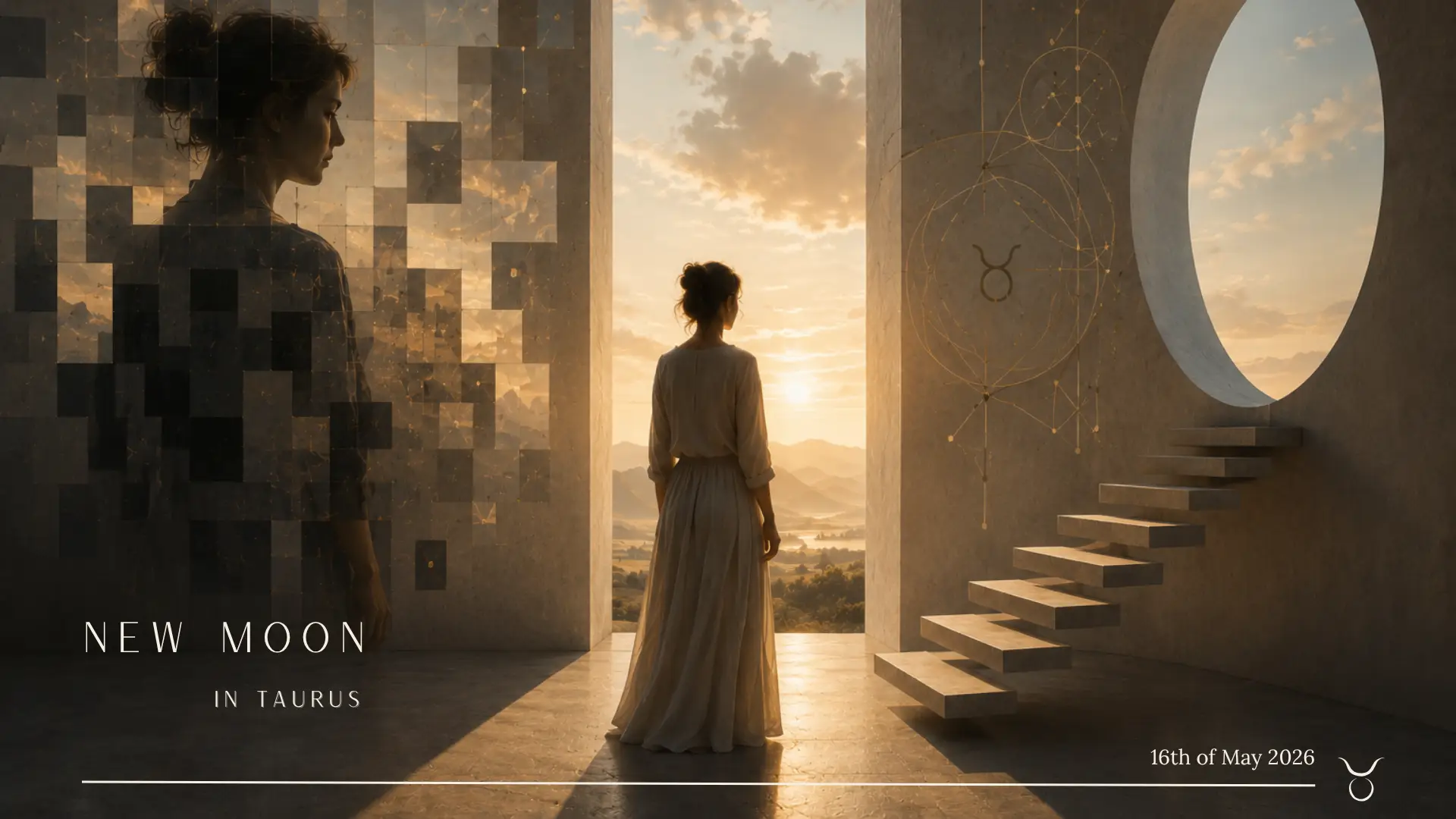
This is precisely what this New Moon in Taurus on May 16, 2026 seems to be bringing into focus.
Taurus is often associated with stability, grounding, continuity, and the need for security. But reducing this sign to a simple search for comfort misses something essential about its deeper psychological function. Taurus seeks to build something that can endure. Something capable of offering enough continuity for us to inhabit the world without constantly feeling fragmented, threatened, or internally scattered.
Yet this lunation does not emerge within a climate of peaceful stability. On the contrary, it unfolds within a sky that speaks of transition, of shifting reference points, and of changing mental frameworks. It feels as though we are collectively standing at a threshold — one where certain old forms of security no longer seem capable of containing the living movement that is now trying to emerge.
And perhaps that is the true tension of this New Moon: how do we evolve without falling apart? How do we allow movement and change into our lives without feeling as though we are losing the very structures that help us remain inwardly grounded?
What We Are Really Trying to Secure
When we speak about security, we often think first of tangible realities: money, work, housing, relationships, or the habits that structure everyday life. Yet beneath these visible elements, something much deeper is usually at play. What we are truly trying to secure is not only an external situation. It is also a sense of inner continuity.
This is precisely what the sign of Taurus speaks to. It represents the psychological function that seeks to build enough stability for life to become embodied over time. After the impulse of Aries — that first movement which declares “I exist” — Taurus responds to another question entirely: what can now be maintained, nourished, sustained? What holds enough value to deserve time, energy, and genuine rootedness in the material fabric of life?
This is why Taurus is so deeply connected to the body, to rhythms, habits, resources, and the permanence of familiar reference points. Not out of simple conservatism, but because human beings cannot live indefinitely in a constant state of disruption and change. We need stability in order to feel inwardly held. We need points of continuity that allow us to move through life without the constant sensation that everything might collapse beneath us.
And I believe this is an important nuance today. In many contemporary narratives, change is often glorified as proof of growth or evolution, while the need for stability is sometimes portrayed as resistance or fear. Yet without enough inner structure, true transformation cannot actually take place. A psychological system with no continuity does not transform — it fragments.
This is what makes this New Moon particularly interesting. It does not seem to oppose security and evolution. Rather, it questions the moment when certain forms of security gradually stop supporting life itself. As though some of the structures that once provided inner stability are no longer capable of holding what is now trying to emerge.
And this is often why periods of transition become so destabilising. Not because everything suddenly disappears overnight, but because some part of us begins to sense that our old ways of functioning no longer create the same feeling of inner coherence. What once felt reassuring no longer holds us in quite the same way. Not because that security was “false,” but because something within us is itself evolving.
When Old References No Longer Feel Sufficient
This New Moon takes place in the final degrees of Taurus. In astrology, this detail is far from insignificant. A sign nearing the end of its cycle no longer expresses its core principle in a simple or instinctive way. It often reaches a threshold — as though the logic it carries has already been extensively developed, tested, and consolidated. The question is no longer simply: how do we create stability? It becomes: does this stability still allow life to move and breathe freely?
This is precisely where this lunation becomes psychologically compelling. It seems to illuminate that subtle and often difficult moment when a structure that has supported us for a long time gradually becomes too narrow to contain the evolution now unfolding within it. And more often than not, this shift does not initially appear as an obvious crisis. It first emerges in quieter, more diffuse ways: a sense of inner fatigue, inertia, repetitive emotional patterns, or the inability to reconnect with movement and desire where there was once vitality and meaning.
Collectively, we are moving through a period in which many psychological, relational, and social frameworks seem to be losing their ability to provide a sense of continuity. And this can be deeply destabilising, because the human psyche naturally tries to preserve whatever has helped it remain coherent and intact. Even when certain structures become limiting, there is often a profound fear surrounding what might emerge in their place.
This is where the presence of Uranus in Gemini feels especially significant. Uranus often acts as a force of disruption — not destruction for its own sake, but a principle that fractures what has become too rigid within the individual or collective system. In Gemini, this mutation appears to affect our mental frameworks more directly: the way we think, interpret reality, create meaning, communicate, and relate to information itself.
And perhaps this is exactly what many people are currently sensing without fully being able to articulate it: the feeling that older models of thought are no longer capable of containing the complexity of the world we are now living through.
What makes this period so unique is that change no longer seems limited to external conditions alone. It is gradually touching the very structures through which we organise our perception of reality. Our certainties, value systems, ways of defining ourselves, relating to others, and constructing psychological security are themselves beginning to shift.
And in this context, it becomes understandable that some people cling even more tightly to older forms of stability. When our mental reference points themselves begin to move, insecurity can quickly become existential. Yet this New Moon seems to pose another question entirely: how do we create a form of stability that is alive enough not to depend on freezing movement itself?
Between Psychological Openness and the Need for Control
Within this atmosphere of transition, the mind occupies a particularly important place. This New Moon is conjunct Mercury, and that detail adds an essential layer to the overall landscape of the chart: what is currently transforming does not only concern our external conditions of security, but also the way we think, interpret, and make meaning of our experience.
When the psyche moves through a period of transition, the mind can become a remarkable tool for integration. It allows us to put words to what we are living through, to connect previously disconnected experiences, and to restore movement where fear or inertia might otherwise solidify. At its healthiest, Mercury introduces psychological flexibility. It helps us shift perspective, question assumptions, and open new pathways of understanding.
But this dynamic also has a more defensive side. When our inner reference points begin to destabilise, the mind may try to artificially restore a sense of safety. Not by opening the system, but by attempting to regain control over uncertainty itself. And I believe many people are currently experiencing this tension without fully recognising it.
We are living in a time where information circulates constantly, where narratives multiply endlessly, and where competing paradigms collide at unprecedented speed. Yet this hyperactivity of the mind does not necessarily create greater inner stability. In many cases, it intensifies fragmentation instead. As though the need to understand were gradually becoming an attempt to soothe a deeper form of insecurity.
In this context, it becomes easy to slip into forms of mental rigidity. Clinging to absolute certainties, searching for definitive answers, reducing the complexity of reality into simplistic explanations or fixed positions can all become ways of artificially restoring a sense of inner coherence. And this New Moon seems to question precisely that relationship to control.
Because the movement it illuminates does not seem to call for the complete disappearance of structure or reference points. Rather, it asks for a transformation in the way we inhabit them. The distinction is crucial. Rigid security attempts to prevent change in order to preserve continuity. Living stability, by contrast, possesses enough inner grounding to tolerate movement without needing to freeze reality itself.
Perhaps this is one of the major psychological challenges of this period: learning how to build a form of stability capable of integrating uncertainty without collapsing into disorganisation. Not a security based solely on preserving the familiar, but an inner continuity strong enough to allow life to keep moving even while older structures are beginning to transform.
When Change No Longer Concerns Only Our Lives, but the Way We Perceive Reality
What feels particularly striking about this period is that the transformations currently unfolding do not concern only the external circumstances of our lives. Of course, social, technological, economic, and relational changes are visible everywhere around us. But something deeper also seems to be shifting: the very way we perceive, interpret, and create meaning from reality itself.
With Uranus now moving through Gemini, the collective mutation appears to be gradually leaving behind the sole terrain of material structures and traditional forms of stability in order to directly affect our mental frameworks, communication systems, patterns of thought, and the circulation of ideas. And psychologically, this transition is far from insignificant.
Because our systems of thought are not merely intellectual constructions. They also function as forms of inner security. Our beliefs, worldviews, interpretations of events, and ways of defining ourselves psychologically all contribute deeply to our sense of coherence. When those reference points begin to shift, our entire inner organisation can start to feel destabilised.
I believe we often underestimate how deeply symbolic continuity contributes to our sense of inner stability. We need narratives, frameworks of understanding, and coherent systems of meaning capable of giving shape to the chaos of reality. Yet what this sky seems to illuminate is precisely the moment when certain collective narratives gradually begin to lose their psychological capacity to contain and organise experience.
And this can produce very different reactions. Some people feel an increasing need for rigidity, absolute certainty, or strongly fixed identities. Others move toward opening new ways of thinking — sometimes with excitement, sometimes with vertigo. And between these two extremes, many find themselves oscillating, unable yet to locate a new form of inner balance.
The presence of Venus in Gemini further reinforces this movement toward circulation and psychological mobility. Values themselves seem to be becoming more fluid. Relationships, forms of belonging, modes of communication, and the ways we collectively create meaning are transforming rapidly. What once felt obvious or stable can now begin to feel strangely insufficient, even constricting.
And perhaps this is one of the great challenges of this period: learning how to remain inwardly coherent without needing to freeze reality into older forms. Because when paradigms begin to shift, the danger is not only confusion. It is also the temptation to cling to rigid certainties in order to avoid the discomfort of uncertainty.
This New Moon seems instead to open another possibility altogether: a form of stability alive enough to continue thinking, evolving, and transforming without entirely losing its inner centre.
Learning How to Stay Alive Without Becoming Rigid
There is often a profound confusion between stability and immobility. As though remaining inwardly coherent necessarily meant preserving the same reference points, behaviours, or definitions of self throughout time. Yet life itself never functions this way. Everything that lives transforms, shifts, and reorganises continuously. Our inner world is no exception.
But when a period of transition becomes especially intense, a more archaic fear can quickly emerge: the fear of losing our inner continuity altogether. And it is often at precisely this point that mechanisms of rigidity begin to appear.
Control, the need for absolute certainty, fixed identities, or closed systems of thought can all become attempts to preserve a sense of psychological stability in a world that feels increasingly difficult to contain inwardly.
The presence of Neptune in Aries feels particularly significant in this context. Neptune often acts as a dissolving force upon our usual psychological boundaries. It softens previously stable definitions of self, identity structures, and familiar perceptions of reality. In Aries, this dynamic directly affects the way we assert ourselves, define ourselves, and attempt to exist as distinct individuals.
And this can feel deeply destabilising. Because when the familiar contours of identity begin to shift, it becomes tempting to retreat into more rigid, defensive, and sharply defined positions. As though the psyche were trying to compensate for the growing uncertainty of the external world by tightening its inner structures.
Yet this sky seems to ask for a different kind of stability altogether. Not a stability based on preserving the known at all costs, but an inner continuity flexible enough to tolerate movement, transformation, and even a certain degree of uncertainty.
I find this may be one of the great psychological lessons of this period: understanding that inner solidity does not always depend on our ability to prevent change. It can also emerge from our capacity to remain connected to ourselves while older forms are gradually evolving. In many ways, this echoes what Carl Gustav Jung associated with the process of individuation: not becoming someone else entirely, but gradually becoming more deeply and consciously oneself through the transformations of life.
And that distinction matters deeply. A living psychological system is not a frozen one. It is a system capable of reorganising itself without entirely losing its inner coherence. Capable of moving through uncertainty without immediately hardening in order to survive.
Perhaps this is ultimately what this New Moon in Taurus is inviting us to remember: true security is not always the absence of movement. Sometimes it resides in the ability to remain inwardly present while the world, our reference points, and even certain parts of ourselves are already beginning to transform.
Final Thoughts
There are periods in life when change still feels like a distant possibility. And then there are those moments when something has already begun shifting beneath the surface, even though the new forms have not yet fully appeared. I believe this New Moon belongs to that second category.
Collectively, we are moving through a transition that affects not only our external lives, but also our relationship to security, identity, meaning, and the inner structures through which we orient ourselves in the world. And during such periods of transformation, it can become difficult to distinguish between what is genuinely trying to evolve within us and what the psyche is simply trying to preserve in order to maintain coherence.
At its deepest level, astrology does not seem to me to exist in order to predict or simplify these passages. What it can offer instead is a symbolic language capable of illuminating some of the invisible dynamics unfolding within our lives. Not to imprison us within fixed definitions, but to help us better understand the tensions, movements, and transformations we are experiencing internally.
Because beneath every period of transition, there is often a more essential question waiting quietly underneath it all: what within us is now trying to continue living differently?
And perhaps it is precisely during these moments of inner transition that a natal chart reading can become meaningful. Not as a ready-made answer, but as a space of reflection capable of bringing greater awareness, coherence, and understanding to certain stages of our journey.