Integrative Astrology

This category is dedicated to integrative astrology, an approach that views astrology as a symbolic language capable of illuminating human experience.

The articles explore the meaning of planets, houses and astrological configurations, as well as the way a natal chart can become a space for deeper self-understanding.

Astrology is approached here as a practice of interpretation and self-knowledge, at the intersection of symbolism, psychology and the observation of the sky.

A flock of swallows and a solitary swallow symbolising belonging and individuation in June 2026 astrology.
Integrative Astrology

June 2026 Astrology: When Belonging Meets Individuation

The Illusion of Security The strong Cancer emphasis throughout June naturally draws our attention to themes of emotional security, attachment, and protection. These themes are certainly present, yet they seem to represent only the most visible layer of a much deeper process. For behind the question of security often lies the question of attachment, and behind attachment lies the question of belonging. We tend to think of belonging as something self-evident. Yet it takes many forms, some of them almost invisible. We belong to a family, a culture, a generation, a set of values, and to collective narratives that shape our understanding of the world and our place within it. This sense of belonging is not expressed solely through our opinions or conscious choices. Over time, it becomes woven into the ways we protect ourselves, love, relate to others, and sometimes even into the very foundations of our inner value system. Strategies of Attachment As we move through life, we develop emotional strategies designed to preserve connection. Some are obvious. Others operate at a far subtler level. They may take the form of silent loyalties to our family history, fidelity to certain relational roles, a reluctance to question beliefs shared by our environment, or a tendency to favour acceptance over differentiation. What these strategies have in common is their capacity to maintain continuity and preserve a sense of belonging. June appears to introduce a fundamental question: what happens to these mechanisms when psychological growth requires a greater degree of differentiation? This question echoes a theme I explored more deeply in my article on astrology and personal transformation. A Creative Tension Emerges This question seems particularly visible in the dialogue between Mercury in Cancer and Pluto in Aquarius. On one side, we find a mental function oriented toward understanding our emotional needs and the strategies we have developed to meet them. On the other, a transformative force acting upon our relationship with the collective and the way we define ourselves within it. The tension does not appear to oppose security and change, nor belonging and autonomy. Instead, it illuminates a deeply human ambivalence: our simultaneous need to remain connected and to become more fully ourselves. This ambivalence deserves careful attention. Many of our emotional strategies are rooted in our capacity to maintain certain forms of connection. They have helped us find our place, feel recognised, and in some cases survive difficult psychological experiences. Questioning them can therefore feel threatening. Yet there are moments when what once protected us also begins to limit us. Not because these strategies were wrong, but because they were built for an earlier, more conditioned version of ourselves. Neither Separation nor Conformity The work suggested by this month does not seem to require a break from our attachments. It speaks instead of a form of change that does not necessarily require separation. Nor does it celebrate a form of individualism that turns differentiation into an absolute value. The invitation is more demanding than that. It asks us to examine with honesty the relationship between our need for security, our various forms of belonging, and our unfolding process of becoming. Seen from this perspective, Mercury’s central role throughout the month becomes particularly meaningful. The many aspects it receives suggest less a time of decision than a time of reflection and integration. The task is to understand before acting, to discern before choosing, and to clarify before transforming. Discernment becomes the essential condition for an evolution that is neither an impulsive rejection of the past nor an unconscious attachment to structures that have become too restrictive. Perhaps this is June’s most subtle invitation: to recognise that our attachments are not merely the bonds that connect us to others. They are also the invisible structures through which we connect to ourselves. And when those structures begin to evolve, it is not only our relationship to the collective that changes. The very way we inhabit our identity begins to change as well. Exploring Your Own Birth Chart The ways we experience belonging, attachment, emotional security and individuation are deeply personal. While June’s astrology highlights these themes collectively, each birth chart reveals how they are uniquely expressed in an individual’s life. A natal chart reading can offer valuable insight into the patterns, loyalties, strengths and developmental processes that shape your personal journey. If you would like to explore these themes through your own birth chart, you can learn more about my Birth Chart Reading here.

June 2026 Astrology: When Belonging Meets Individuation Read Post »

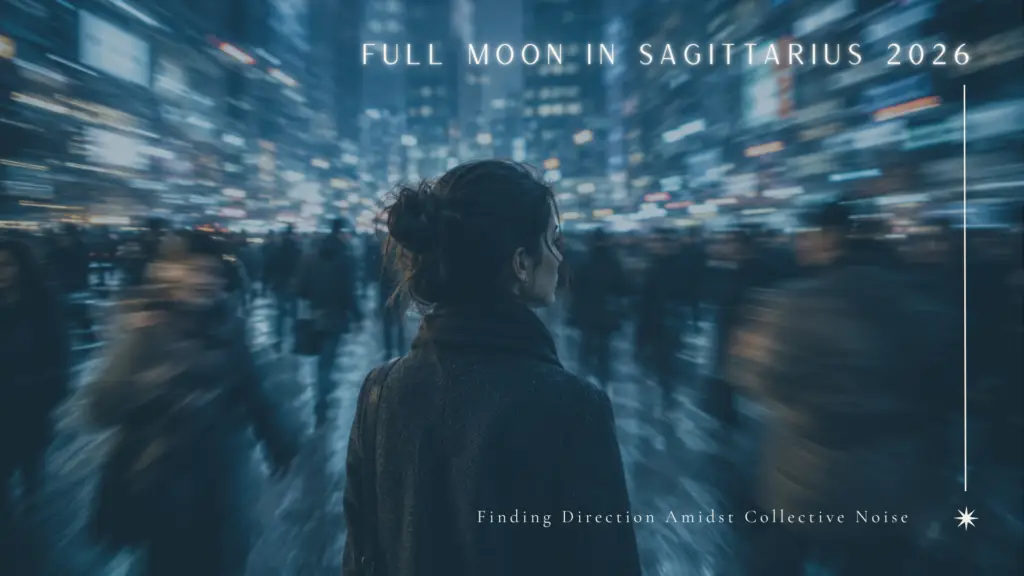
Woman standing still in the middle of a blurred urban crowd symbolizing information overload and the search for inner direction during the Full Moon in Sagittarius 2026
Integrative Astrology

Full Moon in Sagittarius: Finding Direction Amidst Collective Noise

On May 31st, 2026, the Full Moon forms at 9° Sagittarius within an astrological climate that seems to reflect, with striking precision, many of the tensions shaping our current moment. We are living in a time where information, opinions, images and narratives circulate at an unprecedented speed. Never before have human beings had access to such an overwhelming quantity of content, voices and perspectives all at once. Yet this constant multiplication of stimuli does not necessarily create greater clarity. It can also generate a form of inner saturation, making it increasingly difficult to prioritise, to deepen, and to maintain the continuity necessary for reflective and value-aligned thinking. A Consciousness Saturated with Noise This Full Moon brings that tension sharply into focus. Like every Full Moon, it is built upon an opposition between the Sun and the Moon. Here, the Sun stands in Gemini while the Moon moves through Sagittarius, confronting us with two fundamentally different ways of relating to reality. Gemini approaches the world through movement. It explores, connects, compares and shifts perspectives, keeping thought in constant motion. Its function is not to produce an immediate overarching truth, but rather to open perception itself. Gemini introduces nuance precisely where consciousness may be tempted to conclude too quickly. Sagittarius, by contrast, seeks orientation. It attempts to organise experience around a broader vision, a sense of meaning capable of linking scattered fragments into a larger whole. It is not satisfied with endless accumulation of information, but searches instead for coherence, direction and a wider perspective. In a balanced expression, these two functions complement one another. Gemini prevents dogmatism, while Sagittarius prevents thought from dissolving into endless multiplicity without any organising principle. Yet when tension emerges between these two poles, certain distortions can appear. On one side, a constantly stimulated mind incapable of slowing down long enough to truly integrate what it receives. A way of thinking that reacts more than it reflects. A growing difficulty distinguishing what genuinely deserves attention from what merely captures it momentarily. On the other side, a search for rapid certainty. Simplified narratives that create the illusion of clarity amidst chaos. Systems of thought promising reassuring coherence in a world where familiar reference points are becoming increasingly unstable. This polarity is especially visible today. The more fragmented and unstable the world becomes, the more some individuals seem drawn toward totalising visions, emotionally reassuring narratives, or forms of belonging capable of reducing uncertainty. When Thought Becomes Porous The broader climate of this lunation intensifies this dynamic even further. Mercury, ruler of the Gemini Sun, is particularly strong here, positioned in its own sign. Mercurial functions are therefore amplified: accelerated exchanges, mental mobility, multiplying connections, and the rapid circulation of perception itself. But Mercury also forms a square to Neptune in Aries. Neptune rarely operates in direct or obvious ways. Instead, it tends to blur boundaries, making the line between perception, emotion, belief and projection increasingly porous. In a square to Mercury, this can create a growing difficulty in maintaining clear and differentiated thinking. Information no longer circulates merely as facts or ideas. It becomes emotional, contagious and reactive. Narratives spread so rapidly that consciousness sometimes struggles to create enough distance to properly process what it is absorbing. What emerges is a profoundly contemporary phenomenon: the compression of thought itself. The speed of the informational flow gradually reduces the space necessary for reflection. Immediate commentary begins replacing contemplation, while reaction often overtakes the slower process of integration. The Compression of Inner Perspective Within this climate, the Sagittarian capacity for perspective can become difficult to sustain. Because true perspective does not simply mean holding strong opinions or broad visions. It requires distance, time, and the capacity to tolerate uncertainty. It also requires enough inner stability to allow multiple realities to coexist before prematurely forcing them into meaning. This tension between lucidity, distance and maintaining genuine human connection also reminds me of another reflection I recently explored around Aquarius and our contemporary relationship to consciousness, detachment and human complexity in the article “Aquarius: Seeing Further Without Losing Our Humanity.” Yet our era often pushes us in precisely the opposite direction. This Full Moon therefore raises a deeply collective question: how do we continue thinking in a world that constantly pushes us to react? How do we maintain an inner orientation without retreating into rigid certainty? How do we remain open to the complexity of reality without becoming consumed by collective noise? The Search for An Emotional Shelter Jupiter in Cancer, ruler of the Sagittarius Moon, introduces another important layer to this lunation. The search for meaning here carries a deeply emotional undertone. It is no longer only about intellectually understanding the world, but also about finding spaces capable of holding the intensity of the current climate without becoming overwhelmed by it. Jupiter in Cancer seeks refuge, belonging and familiarity. It amplifies the need for emotional safety and, at times, even the desire to feel protected from the outside world. Within a context of cognitive overload, this can lead some individuals toward emotionally reassuring narratives rather than toward genuinely reflective thought. A Deeper Reorganisation of Thought Yet this lunation is not simply pessimistic or catastrophic. The Gemini Sun also receives support from Saturn in Aries and Pluto in Aquarius. These aspects introduce the possibility of deeper restructuring and transformation. Saturn brings maturation. It slows things down. It pushes us to develop thinking that is more grounded, more conscious and more responsible. Pluto operates even more deeply, urging a radical transformation in the way we process, understand and interpret reality itself. Meanwhile, Uranus conjunct the Sun intensifies the need for intellectual and perceptual autonomy. Because beneath the apparent chaos of our era, something else may also be unfolding: a profound mutation in our relationship to information, thought and collective consciousness. Recovering Differentiated Thought This Full Moon may not ask us to choose between openness and certainty. Instead, it invites us to examine how we are currently constructing our relationship to reality. Are we

Full Moon in Sagittarius: Finding Direction Amidst Collective Noise Read Post »

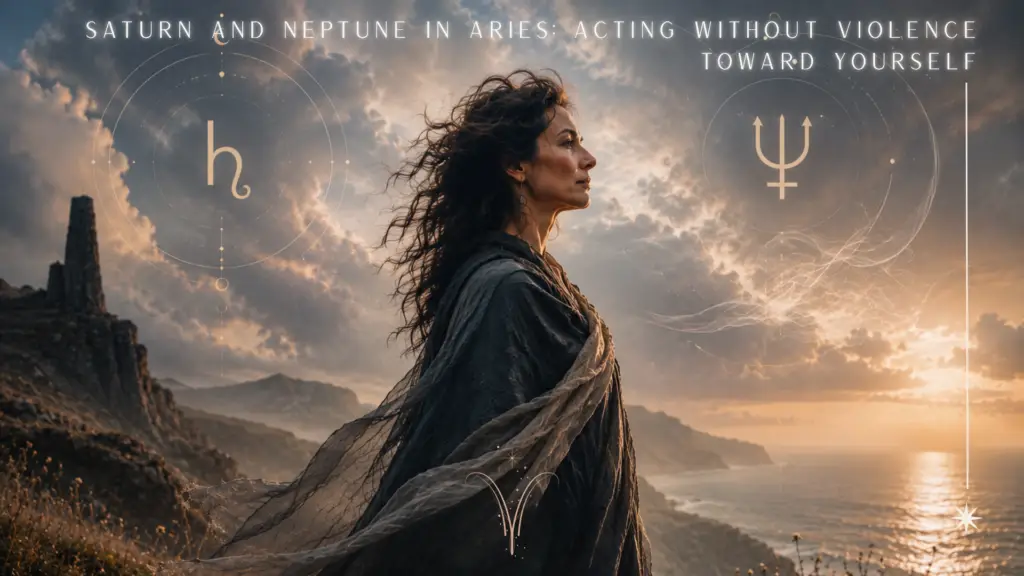
Woman facing the sea with Saturn, Neptune and Aries symbols in a luminous windswept landscape
Integrative Astrology

Saturn and Neptune in Aries: Acting Without Violence Toward Yourself

For some time now, I’ve noticed that many women carry a diffuse feeling that an old way of living is reaching its limit. Some feel the need to leave behind work that has become too confining, while others are trying to reconnect with a more vital relationship to their body, their desire, or their creativity. Beneath these very different movements, however, a shared longing often emerges: the desire to stop living solely through adaptation, performance, or survival. And yet, at the very moment this impulse toward greater freedom begins to surface, another reality often appears with equal force: exhaustion. Not simply the kind of fatigue that comes from lack of rest, but something deeper. As though the body itself were beginning to resist old forms of inner tension. A feeling slowly settles in — the feeling of having to keep holding everything together despite exhaustion, of no longer being able to meet expectations with the same obedience as before, or of sensing a long-contained anger beginning to rise to the surface. A few days ago, a woman I work with said something to me that I haven’t been able to forget: “I’m not being hard enough on myself.” What struck me — almost stunned me — was not only the harshness of the sentence itself, but the complete normality with which it was spoken. As though the idea that we must be violent toward ourselves in order to move forward, succeed, or transform had become entirely self-evident. Yet this way of inhabiting the world is far from insignificant. Many of us learned very early on to ignore our limits, to see exhaustion as a lack of willpower, and to believe we had to constantly push ourselves in order to deserve our place. Violence no longer comes only from the outside; it becomes an inner voice, a silent discipline, sometimes even an identity. This is where the current conjunction between Saturn and Neptune in Aries becomes symbolically meaningful. Not as a promise of spectacular predictions, but as an image of a deeper collective tension: how do we recover our capacity to act without reproducing old forms of inner mistreatment? Saturn and Neptune in Aries: A Tension of Our Time The current meeting between Saturn and Neptune in Aries seems to resonate deeply with this question. Not because it predicts precise events or foreseeable upheavals, but because it offers a particularly compelling symbolic image of the psychological climate we are collectively moving through. Aries has traditionally been associated with impulse, self-assertion, beginnings, and the courage to act. In its rawest expressions, it speaks to survival instinct, willpower, confrontation, and at times combat itself. Saturn, meanwhile, introduces themes of responsibility, reality, and embodiment. Neptune’s role appears more diffuse, yet no less essential. For several years now, many people have experienced a growing disillusionment with the models of success and strength upon which our societies have largely been built. Certain forms of hardness once celebrated — relentless self-optimization, hyper-control, the ability to keep going at all costs — are gradually losing their inner legitimacy. What was once perceived as maturity, discipline, or courage can now feel more like a form of disconnection from oneself. Many people experience a fatigue that goes beyond simple lack of rest; it reflects a growing difficulty in continuing to psychologically adhere to demands that have become increasingly unlivable. I have explored elsewhere the way certain periods of crisis or disorientation can reveal a deeper misalignment between the life we are living and what is trying to emerge within us. But what strikes me today is the way so many women continue responding to this tension with even greater harshness toward themselves. From this perspective, Neptune does not so much remove the need for action as gradually dissolve the heroic myths upon which our way of acting has long been built. The conjunction between Saturn and Neptune in Aries creates a very particular tension: that of a time that still pushes us toward self-assertion and engagement while simultaneously questioning the forms of inner violence once considered necessary for transformation. When Courage Stops Being a War Against Yourself For a long time, our ideas about courage were shaped around heroic figures who embodied the ability to endure, conquer, withstand, or surpass their own limits. Strength was associated with endurance, self-mastery, and sometimes even a certain form of emotional numbness. To keep going despite exhaustion, to continue despite suffering, or to silence one’s vulnerability could all be seen as signs of maturity and worth. These models have profoundly shaped the way we inhabit the world, including within spaces supposedly devoted to healing, consciousness, or personal transformation. The capacity to “work on oneself,” optimize one’s life, overcome one’s fears, or fully embody oneself can sometimes become yet another way of placing ourselves under pressure. Even the language of freedom or empowerment can reproduce very old patterns of performance and inner hardness. I believe this is precisely where something is beginning to shift. Because the meeting between Saturn and Neptune in Aries does not merely question our capacity to act; it also challenges the way we define strength itself. The old myth of the warrior — the one who advances by cutting himself off from sensitivity, limits, or the need for connection — seems to be gradually losing its symbolic power. Another figure appears to be emerging, though perhaps more difficult to recognize because it aligns less easily with the models of success our societies reward. A figure capable of acting without turning her own body into a battlefield. A way of moving forward no longer rooted in the denial of vulnerability, but in a more conscious relationship to life itself. I was deeply moved recently by a phrase from astrologer Rob Brezsny regarding this conjunction: “warriors who fight not to win but to learn how to remain in love with life.” This image feels profoundly different from the heroic ideals we are accustomed to. It speaks neither of conquest nor domination, but

Saturn and Neptune in Aries: Acting Without Violence Toward Yourself Read Post »

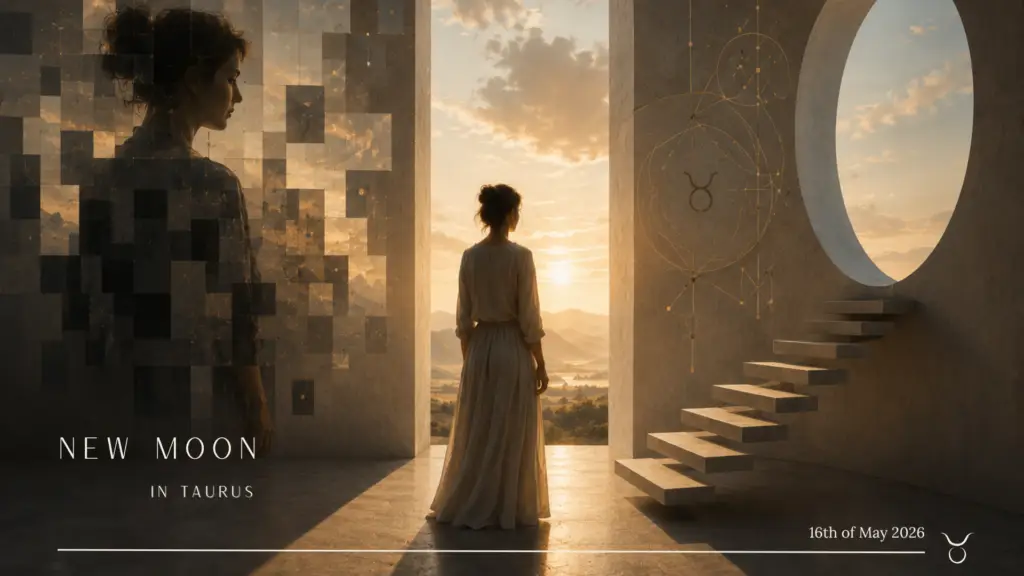
Symbolic illustration for the New Moon in Taurus 2026 exploring inner transformation, shifting psychological foundations, and changing perceptions of stability.
Integrative Astrology

New Moon in Taurus 2026: Changing Without Losing Yourself

Lately, I’ve been noticing how central the question of security has become in our lives. Not only on a material or economic level, although those dimensions are obviously part of the picture. Something deeper seems to be touched. As though many people are sensing, often without fully being able to name it, that the structures they once relied on no longer provide the same sense of inner stability they once did. What strikes me most is that this insecurity does not always come from a clearly identifiable external event. Sometimes it emerges even when, outwardly, everything still appears to be holding together. It can feel more like a subtle internal shift — the sensation of having reached the limits of a certain way of functioning, thinking, protecting ourselves, or inhabiting reality itself. This is precisely what this New Moon in Taurus on May 16, 2026 seems to be bringing into focus. Taurus is often associated with stability, grounding, continuity, and the need for security. But reducing this sign to a simple search for comfort misses something essential about its deeper psychological function. Taurus seeks to build something that can endure. Something capable of offering enough continuity for us to inhabit the world without constantly feeling fragmented, threatened, or internally scattered. Yet this lunation does not emerge within a climate of peaceful stability. On the contrary, it unfolds within a sky that speaks of transition, of shifting reference points, and of changing mental frameworks. It feels as though we are collectively standing at a threshold — one where certain old forms of security no longer seem capable of containing the living movement that is now trying to emerge. And perhaps that is the true tension of this New Moon: how do we evolve without falling apart? How do we allow movement and change into our lives without feeling as though we are losing the very structures that help us remain inwardly grounded? What We Are Really Trying to Secure When we speak about security, we often think first of tangible realities: money, work, housing, relationships, or the habits that structure everyday life. Yet beneath these visible elements, something much deeper is usually at play. What we are truly trying to secure is not only an external situation. It is also a sense of inner continuity. This is precisely what the sign of Taurus speaks to. It represents the psychological function that seeks to build enough stability for life to become embodied over time. After the impulse of Aries — that first movement which declares “I exist” — Taurus responds to another question entirely: what can now be maintained, nourished, sustained? What holds enough value to deserve time, energy, and genuine rootedness in the material fabric of life? This is why Taurus is so deeply connected to the body, to rhythms, habits, resources, and the permanence of familiar reference points. Not out of simple conservatism, but because human beings cannot live indefinitely in a constant state of disruption and change. We need stability in order to feel inwardly held. We need points of continuity that allow us to move through life without the constant sensation that everything might collapse beneath us. And I believe this is an important nuance today. In many contemporary narratives, change is often glorified as proof of growth or evolution, while the need for stability is sometimes portrayed as resistance or fear. Yet without enough inner structure, true transformation cannot actually take place. A psychological system with no continuity does not transform — it fragments. This is what makes this New Moon particularly interesting. It does not seem to oppose security and evolution. Rather, it questions the moment when certain forms of security gradually stop supporting life itself. As though some of the structures that once provided inner stability are no longer capable of holding what is now trying to emerge. And this is often why periods of transition become so destabilising. Not because everything suddenly disappears overnight, but because some part of us begins to sense that our old ways of functioning no longer create the same feeling of inner coherence. What once felt reassuring no longer holds us in quite the same way. Not because that security was “false,” but because something within us is itself evolving. When Old References No Longer Feel Sufficient This New Moon takes place in the final degrees of Taurus. In astrology, this detail is far from insignificant. A sign nearing the end of its cycle no longer expresses its core principle in a simple or instinctive way. It often reaches a threshold — as though the logic it carries has already been extensively developed, tested, and consolidated. The question is no longer simply: how do we create stability? It becomes: does this stability still allow life to move and breathe freely? This is precisely where this lunation becomes psychologically compelling. It seems to illuminate that subtle and often difficult moment when a structure that has supported us for a long time gradually becomes too narrow to contain the evolution now unfolding within it. And more often than not, this shift does not initially appear as an obvious crisis. It first emerges in quieter, more diffuse ways: a sense of inner fatigue, inertia, repetitive emotional patterns, or the inability to reconnect with movement and desire where there was once vitality and meaning. Collectively, we are moving through a period in which many psychological, relational, and social frameworks seem to be losing their ability to provide a sense of continuity. And this can be deeply destabilising, because the human psyche naturally tries to preserve whatever has helped it remain coherent and intact. Even when certain structures become limiting, there is often a profound fear surrounding what might emerge in their place. This is where the presence of Uranus in Gemini feels especially significant. Uranus often acts as a force of disruption — not destruction for its own sake, but a principle that fractures what has become too rigid within the individual

New Moon in Taurus 2026: Changing Without Losing Yourself Read Post »

woman looking at horizon subtle network sky aquarius astrology meaning consciousness
Integrative Astrology

The Aquarius Archetype: Seeing Further Without Losing the Human Connection

An often idealized vision of Aquarius In contemporary astrological discourse, Aquarius is often associated with awakening, consciousness, and progress. In astrology, the meaning of Aquarius is frequently linked to this ability to step back and perceive the world from a broader perspective. It is described as a forward-looking sign, carrying a wider vision, capable of moving beyond individual concerns to engage with collective dynamics. This perspective highlights an essential quality: the ability to gain distance. This capacity for perspective allows connections to emerge where fragmentation once prevailed. It fosters a more global understanding of situations, an ability to think in systems, to grasp underlying dynamics rather than remaining at the level of appearances. In a world shaped by rapid transformation, this analytical and anticipatory capacity is a true strength. Yet when this vision becomes idealized, it tends to obscure a more subtle and demanding dimension of Aquarius. Because seeing more broadly, as valuable as it is, does not in itself guarantee a deeper relationship with what is alive. Understanding Aquarius in astrology: beyond common assumptions One of the common misunderstandings around Aquarius energy lies in the confusion between understanding and relating. Seeing further, identifying patterns, recognizing inconsistencies does not necessarily mean being in relationship with what is being lived. It is possible to understand without truly encountering. At certain moments, this analytical capacity can even create distance. Experience is observed, decoded, sometimes even anticipated, but no longer lived in the same way. A form of lucidity emerges, yet it may come with a subtle withdrawal. This is not a mistake. It is a tension inherent to this mode of functioning. When thought steps back, it can disengage from the sensitive realm, where the deepest transformations actually take place. The gradual shift into distance As awareness expands, another movement may appear: a subtle distancing. Reality is perceived with greater clarity, human limitations become more visible, and sometimes more difficult to hold. In this context, there can be a temptation to correct, to improve, to accelerate what seems not yet aligned. This posture, often driven by a sincere intention to evolve, can nonetheless create a rupture in connection. The other is no longer met in their lived experience, but perceived through what they could or should become. The relationship shifts into a form of adjustment, where human complexity risks being reduced. This dynamic can also turn inward. An inner demand arises, making it more difficult to welcome what is still unfolding. What is not yet understood or integrated can be perceived as something to fix, rather than something to move through. A tension at the heart of lived experience In psychology practice, this tension often appears in a very tangible way. It emerges in those who have developed a strong capacity for understanding, who perceive underlying dynamics clearly, yet struggle to remain connected to what is being lived in the present moment. It can take the form of impatience with recurring patterns, discouragement in the face of slow transformation, or a gradual withdrawal when the gap between understanding and lived experience becomes too wide. In these moments, lucidity is not enough. It illuminates, but it does not transform on its own. Something else is required: the capacity to remain present, even where understanding does not immediately resolve the tension. Integrating perspective without losing connection The invitation is not to renounce this capacity for perspective, nor to question the value of understanding. It is to integrate it into a living relationship with oneself and with others. Remaining connected, even when we can see further, requires accepting that everything does not evolve at the same pace. It asks that we do not reduce experience to what we understand of it, but continue to meet it in its lived, embodied dimension. This way of approaching Aquarius in astrology invites us to move beyond a purely intellectual reading and return to something more experiential. It also calls for recognizing that human complexity cannot be fully grasped through analysis. It requires a space where lucidity and uncertainty, clarity and fragility, can coexist. Another way of inhabiting Aquarius Perhaps the deeper work of Aquarius does not lie solely in expanding consciousness, but in maintaining a connection with what remains imperfect, unfinished, and in transformation. It is not about choosing between understanding and feeling, between stepping back and staying engaged in experience. It is about holding both. To inhabit this tension, without rushing to resolve it, opens a different space. A space where consciousness is no longer a tool for distancing, but a way of relating more finely, more precisely, and in greater respect of the rhythm of life. This movement extends beyond our inner world. It also shapes how we relate to the world itself. As Edgar Morin reminds us: “More and more fundamental questions arise: what are we going to do? Where are we going? What should development look like? We now know that it is not simply a matter of rushing into technological progress, but that there are other things to think about and to do in order to build the future.” In other words, it is not only about going further. But about not losing, along the way, what makes us human. If this reflection resonates with what you are going through, these dynamics can be explored more deeply through a natal chart reading.

The Aquarius Archetype: Seeing Further Without Losing the Human Connection Read Post »

birth chart reading illustration showing a woman in reflection and inner awareness
Integrative Astrology

Birth Chart Reading: What It Really Changes in Your Life

Looking for a birth chart reading is never a trivial step. It is something I observe very often: people don’t come to it at the beginning of their journey, but at a moment when their usual reference points are no longer enough, when the answers they once found no longer hold, and when something deeper is asking to be understood differently. What they are seeking is not just information about themselves. They are looking for a sense of coherence — a way to connect what they are experiencing without being able to make full sense of it. There is often a fatigue of going in circles around the same questions, the same situations, the same dead ends, along with a still vague intuition that what is unfolding goes beyond what they can grasp on their own. In this context, a birth chart reading is often seen as a tool for clarity. A way to access something more stable, more reliable, almost objective about who they are and what they are going through. This expectation is understandable. It reflects a need to orient oneself, to regain an inner alignment. But this expectation is partly based on a misunderstanding. What People Often Expect from a Birth Chart Reading Most people come to a birth chart reading with a relatively clear expectation, even if it is not always explicitly stated. There is often the idea that an external perspective could finally bring something stable, reliable, almost unquestionable about what they are experiencing. Some expect a form of confirmation, as if their inner experience could be validated by a structured reading. Others are looking for an opening — a shift — the possibility of seeing a direction that has not yet become clear on their own. But beyond these expectations, there is often a deeper projection: the idea that the birth chart could bring order to what has so far been experienced as fragmented, contradictory, or unclear. What I also encounter very often is a more intimate and quieter desire: the desire to be seen without simplification. To have one’s experience acknowledged in its complexity, without being reduced to categories or quick explanations. And yet, a tension is already present here. Because behind the search for clarity, there is sometimes the hope that this clarity will remain comfortable — as if seeing more clearly would not require any repositioning. What Actually Happens During a Birth Chart Reading With Me In my way of working, a birth chart reading does not provide answers in the usual sense of the term. It does not deliver a final explanation or a fixed interpretation. It brings to light an internal organization — a unique way of relating to oneself, to others, and to the world. In other words, it does not simply describe who you are. It reveals how your experience unfolds. And often, what emerges is not what was expected. This shift is essential. Because it introduces a crucial nuance: you do not leave a birth chart reading with a fixed identity, but with a more refined understanding of the dynamics at play. What a Birth Chart Reveals at a Deeper Level A birth chart reading goes far beyond identifying personality traits. It allows access to a deeper organization, often less visible but profoundly structuring in a life. In my readings, what emerges are recurring dynamics: ways of relating, positioning oneself, and responding to certain situations that unfold across time and contexts. Not as fixed patterns, but as inner movements seeking expression, sometimes in conflicted ways. I also observe tensions — not as problems to be solved, but as living zones carrying potential for growth. Different parts of the self may seem to move in different directions, and this divergence, often experienced as uncomfortable, can become a powerful point of support for deeper work. A birth chart reading also highlights impulses that have not always found their place. Aspects of oneself that have been set aside, minimized, or made invisible over time, yet continue to operate in the background. What is often striking is how certain elements begin to make sense once they are placed within a broader perspective. What once seemed isolated, inconsistent, or even problematic becomes understandable within a larger inner logic. This is often where something shifts. Not because an answer is given, but because a structure becomes perceptible. And this perception opens the possibility of a different relationship to oneself. Why a Birth Chart Reading Can Become a Turning Point Once certain dynamics are seen, named, and understood, it becomes difficult to continue experiencing them unconsciously. This does not mean that everything changes overnight, nor that difficulties disappear. But something in the relationship to what is being lived changes deeply. From what I observe, this shift does not occur at the level of external events, but at the level of perception. What once felt like a dead end can begin to be seen differently. Repetitions become visible. Tensions that were endured can be recognized as meaningful. This change in perspective has very concrete effects. It allows, for example, a situation to no longer be interpreted automatically as a failure, but as the expression of a deeper dynamic at work. It also opens the possibility of making different choices — not by forcing change, but by aligning more closely with what is truly at stake. There is also a particular form of relief that can emerge here. Not because everything becomes simple, but because an inner struggle begins to soften. What was confusing becomes clearer. What was endured can begin to be integrated. What creates the turning point is not the reading itself. It is the moment when what has been seen can no longer be ignored. And from that moment on, even if nothing visible changes immediately, something has already shifted. And that shift quietly transforms what comes next. An Approach Centered on Understanding There are many ways to approach a birth chart reading. Some are predictive, aiming to anticipate future events.

Birth Chart Reading: What It Really Changes in Your Life Read Post »

birth chart reading in integrative astrology to understand inner dynamics
Integrative Astrology

Birth Chart reading

Birth Chart Reading: Understand the Dynamics of Your Life At certain points in life, something shifts. What once felt stable no longer holds in the same way, and a reorganization begins, often without a clear direction. In those moments, the question is not only “what should I do,” but rather “what is actually unfolding here?” A birth chart reading offers a space for that: to bring perspective to what is being lived, to connect experiences, and to understand the deeper dynamics at play. What is a birth chart reading? A birth chart reading is not about explaining who you are, nor about predicting what will happen. It takes place in an intermediate space, where it becomes possible to read the dynamics shaping a life without reducing them to simple causes or outcomes. Based on the chart calculated at the moment of your birth, it involves observing a network of relationships, tensions, and symbolic configurations which, when brought into perspective, reveal a form of coherence. Not a linear or simplified coherence, but a deeper organization, often sensed but not yet clearly articulated. This work does not define who you are, nor does it prescribe who you should become. Instead, it opens a space where certain experiences, inner conflicts, or impulses can be recognized as part of a larger movement, rather than as isolated or contradictory elements. In that sense, a birth chart reading does not provide answers in the usual way. It offers a shift in perspective, allowing you to relate differently to what you are going through, and to perceive continuity where there may have only been fragmentation. Why have a birth chart reading? A birth chart reading is rarely sought out of simple curiosity. It often arises at a particular moment in life, when something calls to be understood differently. This may be a period of transition, an inner shift that is difficult to name, or a subtle sense of misalignment between what is being lived and what could emerge. In such moments, familiar reference points are no longer sufficient. The answers that once worked begin to lose their resonance, and a deeper questioning takes shape, sometimes without clear words. What is being sought is not an immediate answer, but a way to situate the experience, to begin to grasp its coherence. A birth chart reading offers a framework for reflecting on these passages. It allows experiences that once felt disconnected to be placed in perspective, recurring patterns to be recognized, and tensions to be illuminated without being prematurely resolved. It opens a space where what is being lived can be approached differently, not in order to escape it, but to understand its necessity and its meaning. Within this approach, the aim is not to find ready-made answers or confirm a predefined direction, but to become available to a more nuanced reading of one’s own path. From that place, choices can emerge in a more conscious and aligned way, less driven by unseen patterns. What a birth chart reading offers A birth chart reading does not change a situation in itself, but it can profoundly shift the way you relate to it. Often, this is where something becomes possible—not because external circumstances change, but because your perspective becomes wider and more precise. It first allows for experiences that were previously diffuse or difficult to grasp to be put into words. Certain feelings, tensions, or inner movements become more readable, not as problems to fix, but as expressions of underlying dynamics already at work. This movement from raw experience to structured understanding creates a first shift, moving beyond a purely reactive or emotional relationship to what is happening. It also offers a framework to recognize recurring patterns. Not as fixed repetitions, but as movements seeking to unfold, which may continue to repeat when they remain unrecognized. The reading helps situate these patterns within a broader context, allowing for a form of discernment where there may have only been a sense of being caught in something. It also introduces a different relationship to time. Rather than seeing a situation as isolated, it places it within cycles, phases, and processes of development. This perspective does not diminish what is being lived, but situates it within a larger unfolding, which can deeply shift the experience of urgency, waiting, or the need to resolve. Finally, it creates a space where it becomes possible to relate to yourself differently. Not by defining or fixing who you are, but by recognizing the complexity of your inner movements without needing to simplify them. It is often from this space that a more refined and authentic form of adjustment can emerge. What it is not A birth chart reading is not about predicting the future. It does not aim to anticipate events or provide definitive answers about what will happen. This distinction is essential, as it shapes the entire approach: the chart is not used as a tool of projection, but as a way to understand the present through a symbolic structure. It is not a fixed definition of who you are. The birth chart is not an identity to conform to, nor a set of traits to adopt as truth. Reducing it in that way would freeze something that is inherently in movement. The reading does not tell you who you are, but illuminates the dynamics you are in relationship with. It is not a diagnosis, nor an external framework imposed onto your life. The reading does not deliver a truth to be applied. It opens a space of dialogue. What emerges during the session is not an interpretation to follow, but a perspective from which you remain free to position yourself. Finally, it is not a quick solution. It does not aim to resolve a situation immediately or bypass complexity. Instead, it allows you to look at what is happening with greater clarity, which can, over time, open more aligned ways of responding. How a session unfolds A birth chart reading takes place as a

Birth Chart reading Read Post »

Soft light illuminating a path, symbolizing life transitions and inner transformation
Integrative Astrology

Astrology and life transitions

For a long time, I would not have been able to name what I was going through, except as a vague sense of losing my bearings — as if something within me was quietly unraveling, without my being able to grasp either its origin or its direction. In those moments, my first impulse was to try to understand, at all costs, as though clarity alone could restore some form of inner stability. The questions kept returning — why me, why now, what am I missing — and I threw myself fully into a search for meaning, exploring different tools and approaches, hoping that one of them would eventually offer an answer solid enough to contain all my uncertainty, my doubts, and my fears. With hindsight, I can see that this search was not so much driven by the urgency to get out of that state, but rather by an almost constant attempt to rationalize what I was experiencing. In the background, there was a persistent, sometimes subtle idea that something was escaping me because I had failed to see, understand, or do what was needed. As if, in some way, this unfolding belonged to my responsibility, and that understanding could somehow repair it. My mind became increasingly active, trying to organize, interpret, and reconstruct a sense of coherence that would allow me to find solid ground again, at a time when everything seemed to be slipping away. What had I overlooked or set aside to get here? Had I lost myself? And how, then, was I supposed to find my way back? Collapse as a Threshold When I speak of finding myself again, I do not mean returning to who I once was, nor restoring a lost balance, but rather reconnecting with myself — with parts of me I could sense but not fully reach. There was an intuition that one part of me was occupying all the space, maintaining a form of control precisely to avoid seeing or feeling what, at a deeper level, would have been too painful to face. As if something within me had chosen to hold everything together at all costs, rather than risk collapse. And yet, at some point, this holding could no longer continue. The body, in a way, took over where the mind could not go any further — and it was the body that gave way, forcing a pause, a rupture in this constant effort to adapt. In a sense, I had to consent to this collapse — not as a failure, but as a necessary passage, almost inevitable, for something else to emerge. What I initially experienced as a loss of control gradually revealed itself as an opening, allowing me to see that I was not a single, unified self, but a constellation of different parts — some that had long supported me, and others that had, without my awareness, begun to limit me. It was no longer only about understanding what was happening to me, but about recognizing these inner voices, learning to listen to them, and perhaps most importantly, beginning to reconnect with something deeper — something I could not yet name, but that I sensed as an inner ground. In Search of Inner Coherence In an attempt to reconnect with this more essential place, I followed many different paths — some inward, some through the body, and others through traditions offering a broader perspective on the human experience. Introspection, meditation, the discovery of Hindu philosophy, body-based practices, and various therapeutic approaches — each brought its own insight, each opened a door, yet none fully met this deeper need for coherence. Because beyond the exploration itself, a tension remained — difficult to soothe: the need to relate what was happening within me to a way of reading it that made sense, without reducing the experience to something that could be entirely explained. What was missing was not the diversity of experiences or approaches, but a thread capable of holding them together. How could everything I had explored be integrated without becoming scattered fragments? How could I prevent this richness from turning into a confusion in which my energy would dissolve? I was looking for a point of orientation — something that could connect, synthesize, and give coherence to what I had experienced, without diminishing its complexity. Something structured, yet neither abstract nor reductively rational. Astrology as a Living Language After two years of training in psychotherapy, a tool that had already appeared earlier in my life — almost quietly — returned with a completely different depth: astrology. Not as a belief system or an external framework of interpretation, but as a structured and living language, capable of linking these different dimensions — psychological, symbolic, and existential — and offering a way of reading what unfolds within us that is both rigorous and open. Where other approaches allowed me to feel in the moment or explore different inner territories, astrology offered a different kind of support, introducing a process that articulates the precision of a technical framework with the intuition that emerges through lived experience. Where psychotherapy brings light to psychological mechanisms and helps unfold unconscious dynamics, astrology proposes a reading of the forces at play, the tensions at work, and the movements of transformation that shape a life — not as fixed elements, but as evolving dynamics. It does not provide answers, nor does it claim to predict what will happen. Rather, it makes perceptible what is already unfolding. It does not confine experience within a definitive interpretation, but opens a space of understanding that remains alive, leaving room for complexity, ambivalence, and what cannot be fully grasped. In this perspective, the birth chart is not an identity to conform to, but a living architecture — a system of inner relationships through which it becomes possible to enter into dialogue with one’s own movements, without reducing or controlling them. This shift is essential: it is no longer about knowing who we are or who we will become,

Astrology and life transitions Read Post »

Scroll to Top