
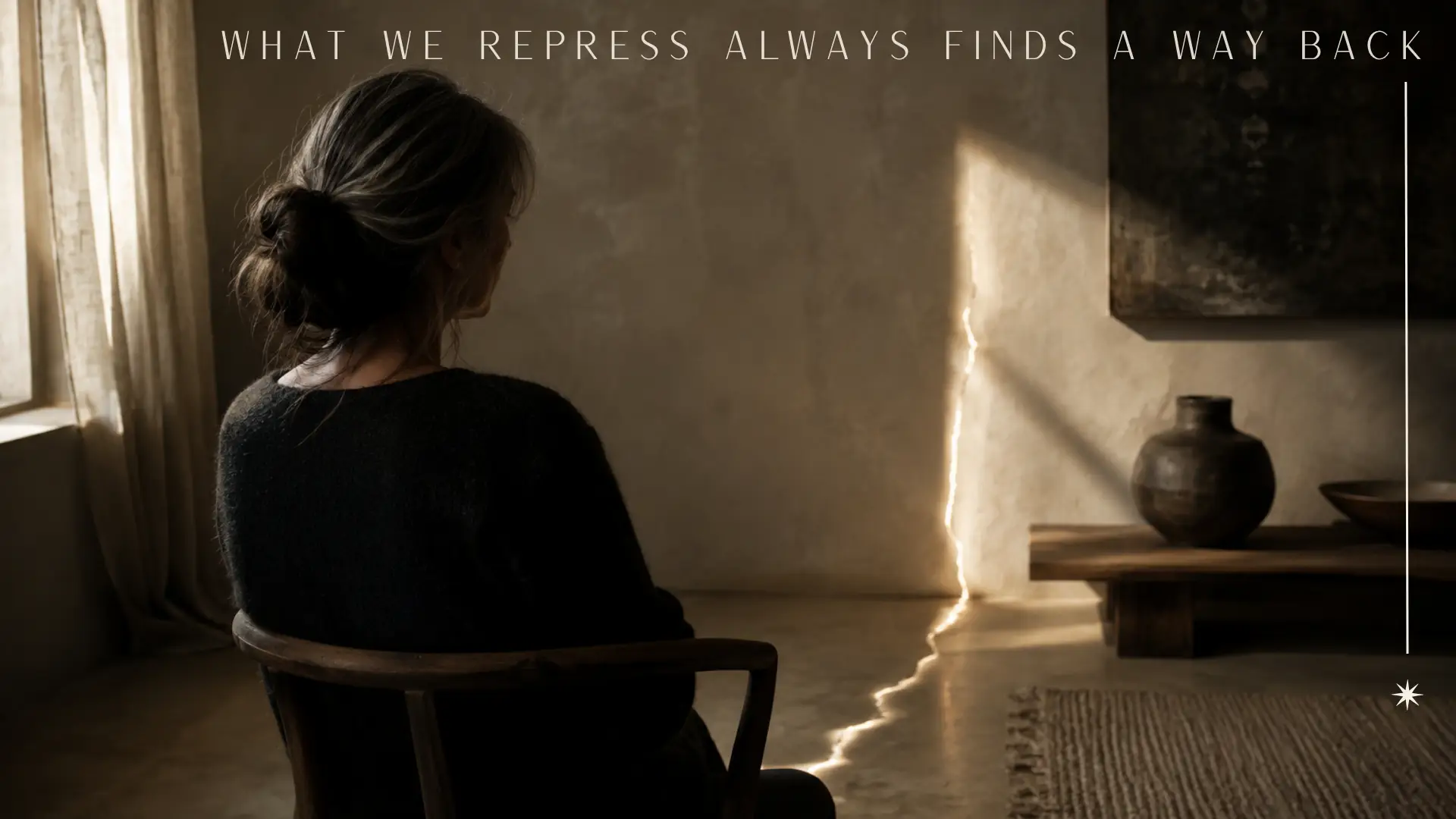
We spend a large part of our lives trying to adapt to our environment. From early childhood, we learn — more or less unconsciously — which behaviours bring us closer to love, safety, or recognition, and which ones might instead lead to rejection, conflict, or abandonment. This adaptation is deeply human; in many ways, it is an essential part of psychological development itself. In order to grow within a particular family, social, and cultural environment, we gradually develop mechanisms designed to preserve our inner balance and our sense of safety.
These mechanisms are not necessarily pathological. Many of them initially emerge as intelligent responses from the psyche to emotional, relational, or affective experiences. Yet over time, some protective strategies can become so ingrained that they slowly turn into enduring ways of being in the world. One person learns to systematically suppress anger in order not to disturb others; another develops constant hypervigilance in an attempt to anticipate the needs and reactions of those around them; another becomes accustomed to saying yes to everything, not out of genuine inner availability, but because some unconscious part of them associates refusal with the threat of rupture, rejection, or loss of love.
What once began as a temporary adaptation can gradually solidify into a deeply rooted psychological pattern. Over the years, these ways of functioning may become so intertwined with our personality that we begin to perceive them as fixed character traits rather than as constructions shaped through our personal history. We no longer clearly see what we have learned to silence, minimise, or transform into repressed emotions, precisely because these mechanisms now operate from areas that have become largely unconscious.
Yet the unconscious is not a static place where unresolved experiences simply disappear forever. What has not been recognised, processed, or integrated often continues to exist beneath the surface of psychic life — sometimes quietly, sometimes in far more disruptive ways. Certain emotions reappear through the body, through reactions that surprise even ourselves, through recurring relational patterns, unexplained exhaustion, or those unsettling moments when an apparently insignificant situation suddenly awakens something much older within us.
Because we do not always react solely to what is happening in the present moment. Certain ordinary situations — a remark, an unanswered message, criticism, a feeling of exclusion, a minor conflict — may resonate with much deeper layers of our inner history. The psyche has its own invisible fault lines. For years, we may maintain an appearance of balance, contain certain emotions, function, move forward, adapt. Then an ordinary scene — seemingly insignificant on the surface — touches an inner saturation point that has existed for far longer than we realise. What emerges in those moments can appear disproportionate; yet such emotional overflow often speaks of something that has been seeking expression for a very long time.
The present moment therefore acts less as an isolated cause than as a revealer. It touches older psychological layers which, although invisible to ordinary consciousness, continue to silently shape the way we feel, perceive, and relate to the world. What we try to keep at a distance does not necessarily disappear; it sometimes simply changes language, until a part of us finally asks to be met.
The Parts of Ourselves We Exile in Order to Adapt
The need to belong is perhaps one of the most fundamental human needs. From early childhood, our emotional and psychological survival depends largely on our ability to maintain connection with those around us. The work of John Bowlby profoundly demonstrated how deeply the need for relational security shapes human development. Very early on, we begin to perceive — often implicitly — which behaviours encourage love, recognition, or safety, and which ones may instead provoke distance, conflict, rejection, or humiliation. Much of our inner construction develops through this sensitive reading of our relational environment.
Within this context, certain parts of ourselves may gradually become more difficult to express or inhabit. Not because they are inherently wrong, but because they appear incompatible with the emotional or familial balance within which we are evolving. A child who senses that their anger disturbs others may learn to suppress it; another may unconsciously understand that their emotional needs feel burdensome to those around them; another may develop strong hyper adaptation in order to preserve harmony within the family system. These adjustments are rarely conscious choices. More often, they emerge as protective strategies designed to preserve connection, emotional safety, or the feeling of being loved.
Over time, these adaptations can solidify into relational identities. Some people build themselves around the role of the one who soothes, understands, cares for others, anticipates everyone’s needs, or never takes up too much space. Others develop constant self-control, difficulty showing vulnerability, or a need for mastery designed to avoid emotional insecurity at all costs. Pediatrician and psychoanalyst Donald Winnicott described this dynamic through the notion of the “false self” — a psychological organisation gradually constructed in response to the expectations of the environment, sometimes at the cost of increasing distance from the spontaneous and living experience of the authentic self. What initially began as a temporary response to a particular environment can eventually shape the personality itself.
The difficulty is that these adaptive mechanisms often involve a form of inner exile. In order to continue belonging, we sometimes learn to distance ourselves from essential dimensions of who we are. We push away emotions considered dangerous, needs perceived as excessive, impulses judged unacceptable, or forms of sensitivity that never found enough space to be welcomed. Gradually, entire aspects of our inner life become invisible not only to others, but also to ourselves.
And what we exile is not necessarily limited to our wounds or fragilities. We may also learn to repress our anger, desire, power, creativity, spontaneity, or ability to set boundaries. Some people become highly skilled at maintaining an image of balance, gentleness, or self-control while internally experiencing a profound tension between what they show and what they truly feel. This gradual dissociation can create a diffuse sense of disconnection from oneself, as though a vital part of one’s aliveness had been kept at a distance in order to preserve a familiar mode of functioning.
The work of psychotherapist and neuroscientist Sue Gerhardt has also highlighted how deeply early relational experiences shape our emotional system and our capacity to regulate stress, fear, and inner safety. In other words, what we learned very early to silence, contain, or anticipate does not simply disappear over time; these adaptations gradually become embedded in the very way we inhabit the world and relate both to ourselves and to others.
This is often where what certain psychological approaches — particularly in the work of Carl Gustav Jung — call the shadow begins to form: not a “bad” part of the personality, but rather all the aspects of ourselves that we have learned to keep outside the field of consciousness in order to continue adapting to our environment. And the more these dimensions remain ignored or rejected, the more they tend to seek indirect ways of existing — sometimes through symptoms, relational tensions, emotional overwhelm, or periods of crisis during which what had long been held at a distance gradually begins to resurface.
When Repressed Emotions Begin to Speak Another Language
What we keep outside the field of consciousness does not necessarily disappear. Psychic life does not function like a static storage space where unresolved experiences can simply be locked away and forgotten forever. What has not been recognised, processed, or symbolised often continues to exist beneath the surface of our inner life — sometimes discreetly, sometimes in much more invasive ways. The unconscious is not silent; it continually seeks indirect ways to express itself.
Certain emotions we have learned to contain therefore begin to reappear elsewhere: through the body, through emotional reactions whose intensity surprises even ourselves, through repetitive relational patterns, chronic anxiety, or a persistent feeling of being inwardly disconnected from one’s own life. What seeks to emerge does not always take the form of a clear memory or immediate insight. More often, it expresses itself through detours, symptoms, tensions, or behaviours that seem, at first glance, unrelated to their deeper origin.
Psychiatrist Bessel van der Kolk has extensively shown how emotionally unintegrated experiences continue to leave traces within the body and nervous system long after the events themselves have passed. Similarly, Gabor Maté highlights how many physical and psychological manifestations may be linked to adaptive mechanisms developed early in life in order to preserve attachment, safety, or belonging. In other words, what we often call “symptoms” does not necessarily reflect an isolated dysfunction; it may also represent an attempt by the psyche — and sometimes by the body itself — to make visible what never truly found space to be heard.
It is often within the most ordinary moments of life that these psychological contents resurface. A seemingly harmless remark, a silence, the feeling of being ignored, a minor criticism, or an apparently insignificant conflict can suddenly provoke a reaction far greater than the situation itself would seem to justify. We may then feel ashamed of the intensity of our own emotions; we tell ourselves that we are “overreacting,” that “it’s not that serious,” without fully understanding why something inside us has been touched so deeply.
And yet we do not react solely from our conscious history or present age. Certain everyday situations resonate with much older layers of our inner experience. The present moment becomes a revealer: it reactivates fears, tensions, emotional memories, or feelings of insecurity that existed long before the triggering event itself. The psyche contains its own invisible fault lines. For years, we may maintain an appearance of balance, function, move forward, adapt to what life asks of us. Then one seemingly insignificant moment touches an inner saturation point that has existed for a very long time. What overflows in that instant may appear disproportionate from the outside; yet such reactions often speak of something that has long been seeking expression.
From a Jungian perspective, these manifestations can be understood as attempts by the psyche to restore balance or compensation. Carl Gustav Jung believed that what remains unconscious tends to silently influence our lives until it can be brought into greater awareness. This does not mean that every form of suffering contains an immediately obvious meaning, nor that simply “listening to our emotions” resolves the complexity of human experience. But it does remind us that the psyche is constantly seeking movement, expression, and sometimes reintegration.
The problem, then, is not so much the existence of these zones of shadow, tension, or vulnerability. The problem emerges when entire parts of our inner life must remain under permanent control in order to preserve an image of ourselves that has become necessary for our relational or social equilibrium. Because what is kept in the dark for too long will often begin searching for another language through which to exist.
When Life Forces Us to Face What We Learned to Avoid
There are periods in life when the psychological mechanisms that once helped us function begin to lose their effectiveness. What could previously be contained, rationalised, or kept at a distance starts resurfacing with a new intensity. Some people encounter these moments through separation, grief, burnout, illness, relational crises, major life transitions, or the profound inner upheaval that often accompanies midlife. Others experience this confrontation through motherhood, menopause, existential emptiness, or the unsettling feeling that the identity they spent years building no longer fully reflects who they have become.
These periods are often destabilising because they weaken the psychological structures upon which we may have relied for decades. What once allowed us to function, adapt, or maintain a sense of inner coherence suddenly becomes far more difficult to sustain. Emotions that had long been contained grow more intrusive; existential questions become impossible to ignore; old vulnerabilities rise back to the surface even when we believed we had already moved beyond them.
In such moments, it is common to feel that “something is wrong” without fully understanding what is actually transforming beneath the surface. Yet these crises do not necessarily create our inner tensions from nothing. More often, they reveal fault lines that already existed but that our psychological organisation had previously managed to keep relatively stable. What begins to collapse is not only an external situation; sometimes it is an entire system of inner adaptation that has become insufficient for what life is now asking of us.
Psychiatrist Carl Gustav Jung saw certain life crises as moments during which the psyche attempts to reorient the personality toward something deeper and more authentic. According to him, what we often call a “crisis” may also reflect a confrontation with dimensions of ourselves that have long been neglected, repressed, or sacrificed in favour of social adaptation. The suffering emerges not only from what rises into consciousness, but also from the difficulty of letting go of the identities with which we once identified in order to survive, belong, or be recognised.
It is also during such periods that symbolic approaches — particularly symbolic astrology — can offer a meaningful framework of interpretation. Not because planets literally “cause” the events or emotional states we experience, but because certain cycles seem to resonate with periods of profound inner transformation. Within a symbolic understanding of astrology, some transits frequently coincide with moments when our usual mechanisms of control, avoidance, or adaptation become increasingly difficult to maintain.
Major cycles associated with the Saturn Return, Pluto transit, or symbolic themes linked to Chiron and Black Moon Lilith often correspond to experiences of inner confrontation, psychological stripping away, or the resurfacing of psychic material that has long been kept in the shadows. What we once learned to avoid gradually asks to be seen differently.
Symbolic astrology therefore becomes less a tool of prediction than a language through which meaning can be brought to periods of disorganisation, transition, or profound psychological transformation. It reminds us that the human psyche is not fixed, and that certain crises may reflect moments when a deeper part of ourselves is trying to reclaim its place within our lives.

The Problem Is Not That We Have a Shadow
A great deal of contemporary psychological suffering seems rooted in an increasing difficulty tolerating human complexity. We live in societies that strongly value self-control, emotional efficiency, positivity, and the ability to maintain a coherent image of oneself. Even certain forms of spirituality or personal development can implicitly reinforce the idea that an “evolved” individual should be capable of quickly transcending contradictions, fears, anger, wounds, or emotional ambivalence. As though inner work consisted of gradually eliminating everything within us that remains uncomfortable, conflictual, or dark.
These forms of inner exile are not constructed solely on an individual or familial level; they are also deeply shaped by collective emotional norms that become internalised over time. Not all emotions are welcomed equally within the cultural, social, and relational environments in which we grow up. Many men learn very early that expressing sadness, vulnerability, or fear threatens their masculine identity and risks exposing them to humiliation, rejection, or shame. Conversely, many women quickly understand that their anger, power, or assertiveness may become socially uncomfortable, leading them to be perceived as excessive, aggressive, or hysterical. In this sense, certain psychological exiles are not merely the result of personal wounds; they are also the product of collective conditioning that implicitly determines which emotions may be expressed, which must remain contained, and which parts of ourselves risk compromising our sense of belonging.
Yet this pursuit of psychological purity can itself become profoundly violent. Human beings are not perfectly unified, transparent, or permanently peaceful structures. We are shaped by tensions, paradoxes, contradictory desires, vulnerabilities, and impulses that do not always coexist harmoniously. Maintaining a constantly luminous, controlled, or spiritually elevated self-image may lead some individuals into a permanent inner battle against dimensions of themselves that are nonetheless deeply human.
In the work of Carl Gustav Jung, the shadow does not refer solely to the darkest or most destructive aspects of personality. More broadly, it points to everything that has been pushed outside the field of consciousness in order to preserve a certain self-image or adaptation to the external world. The shadow may therefore contain anger, jealousy, aggression, or deep fears; but it may also hold far more vital dimensions of the psyche — desire, creativity, power, intuition, sensuality, spontaneity, or the capacity to set boundaries.
In other words, what we reject within ourselves is not always what is “bad” in us. Sometimes it is simply what never found enough safety or recognition to exist freely. Some people learned very early that their anger threatened connection; others that their vulnerability risked humiliation; others that their emotional intensity, sensitivity, or need for space disturbed their environment. Gradually, entire aspects of the personality may be relegated to the shadows not because they are pathological, but because they became incompatible with the identity we had to construct in order to continue belonging.
The issue, then, is not so much the existence of these shadowed dimensions as the immense psychological energy required to keep them under constant control. The more we try to distance ourselves from certain parts of who we are, the more these parts may paradoxically express themselves indirectly, uncontrollably, or symptomatically. Repressed anger may become chronic irritability or emotional exhaustion; a minimised need for recognition may reappear through relational dependency; denied vulnerability may disguise itself through excessive control or difficulty asking for help.
From this perspective, psychological work does not necessarily consist of becoming a perfectly “healed” individual free of all inner contradictions. It may instead involve developing a more conscious, nuanced, and human relationship with what moves through us. Psychological maturity is not based on the absence of shadow, but on the growing capacity to recognise what already exists within us without immediately needing to deny it, project it, or fight against it.
The psychosynthesis of Roberto Assagioli also insists upon this essential idea: we can only truly transform what we are capable of consciously recognising. Rejecting certain parts of ourselves does not make them disappear; it merely keeps them in regions where they continue to act beyond awareness. Conversely, when long-exiled dimensions of the self begin to be seen, named, and gradually reintegrated, something within our psychological vitality can begin to flow more freely again.
This is not about idealising suffering or romanticising the most difficult aspects of human experience. Some wounds require time, support, and genuine therapeutic work. But perhaps there is an important difference between trying to get rid of ourselves and gradually learning to inhabit our own complexity with greater consciousness, responsibility, and inner compassion.
What Seeks to Be Reintegrated
Becoming aware of certain adaptive mechanisms does not make them disappear overnight. Psychological patterns that have been built over years — sometimes since early childhood — do not dissolve simply because they become visible to consciousness. And yet, the very act of recognising certain inner dynamics already begins to transform our relationship to them. What once operated exclusively through shadow, automatic reactions, or unconscious repetition can gradually begin to move again, to be thought about, named, and perhaps lived differently.
This is often where genuine inner work begins: not when we finally become perfectly coherent, peaceful, or “healed,” but when we slowly stop defining ourselves solely through the mechanisms that once helped us survive psychologically. Many of the strategies we developed throughout our lives initially served an essential function. They protected us, helped preserve connection, maintained a sense of inner safety, or allowed us to continue moving forward in environments where certain parts of ourselves could not yet be fully expressed. The difficulty arises when these mechanisms become the only possible way of relating to ourselves, to others, and to the world.
Reintegrating what we have long kept at a distance does not mean expressing everything indiscriminately, nor does it mean erasing all inner conflict. It is not about romanticising the shadow or transforming every form of suffering into a spiritual initiation. Some wounds require time, containment, and sometimes demanding therapeutic work. Yet there is an important difference between being unconsciously governed by certain parts of ourselves and gradually entering into a more conscious relationship with them.
When a long-contained emotion can finally be recognised, when vulnerability no longer feels like an absolute threat, when anger can be heard before it becomes symptom or emotional overflow, something often begins to reorganise itself internally. Not because everything suddenly becomes simple or resolved, but because psychological movement becomes possible again where there had previously only been control, splitting, or avoidance.
In the analytical psychology of Carl Gustav Jung, the process of individuation refers precisely to this gradual movement through which a person becomes more conscious of their own psychological totality. It is not about constructing a perfect version of oneself, but about slowly expanding the capacity to recognise the many dimensions that make up inner life — including those that had long been relegated to the shadows. The psychosynthesis of Roberto Assagioli resonates deeply with this perspective, particularly in its emphasis on gradually disidentifying consciousness from the roles, wounds, and defensive structures with which we have come to define ourselves.
From this perspective, certain life crises may begin to appear differently. Not solely as breakdowns to avoid or dysfunctions to correct as quickly as possible, but also as moments when old psychological structures become too narrow for what is now trying to emerge. What begins to collapse is not always our deepest identity; sometimes it is the adaptive structures we once built in order to belong, to be loved, or to remain safe.
Symbolic astrology can also accompany this perspective by offering a language through which to understand cycles of inner transformation. Certain transits seem to coincide with periods during which the psyche can no longer keep certain contents hidden with the same efficiency as before. What had remained contained gradually asks to be recognised — not necessarily in order to destroy us, but perhaps to allow a more authentic reorganisation of inner life to emerge.
Reintegrating certain parts of ourselves therefore does not mean becoming someone else. It may simply mean slowly ceasing to build our lives against ourselves.
We often spend an enormous amount of energy trying to keep certain parts of ourselves at a distance. Out of fear of suffering, disturbing others, losing love, belonging, or a sense of safety, we learn to contain certain emotions, adapt ourselves, and build identities capable of preserving a psychological equilibrium that may once have been essential to our survival. Yet what is kept in the shadows for too long does not necessarily disappear. It often continues to live through the body, emotional reactions, repetitive relational patterns, periods of crisis, or those moments in life when what once functioned suddenly no longer seems enough.
Perhaps this is precisely where certain struggles begin to take on a different meaning. Not as proof that something within us is fundamentally broken, but as a sign that a part of our inner life is now asking to be recognised differently. What returns is not always trying to destroy us; sometimes it is attempting — awkwardly, painfully, imperfectly — to find its way back into consciousness.
This does not mean idealising suffering or believing that simply “embracing the shadow” resolves the complexity of human experience. Some wounds require time, support, and genuine psychological work. But perhaps we can gradually learn to look differently at what insists on emerging within us, rather than immediately treating these inner movements as enemies to eliminate.
Because behind many defence mechanisms, symptoms, or emotional overreactions there are often parts of ourselves that never truly ceased to exist. Emotions, needs, vulnerabilities, desires, or forms of vitality that, for a very long time, never found enough space, safety, or language to be consciously lived.
And perhaps, ultimately, inner work is less about becoming someone else than about slowly ceasing to build ourselves against certain parts of who we are.
Certain periods of life tend to reactivate what, within us, is asking to be seen differently. In a symbolic approach to astrology, the natal chart and certain astrological cycles can offer meaningful insight into unconscious dynamics, adaptive patterns, inner tensions, but also into the parts of ourselves that are gradually seeking reintegration.
If you would like to explore these questions through a symbolic and psychologically oriented birth chart reading, you can discover my work here.
Further Reading
The reflections explored throughout this article emerge from an ongoing dialogue between analytical psychology, attachment theory, psychosynthesis, affective neuroscience, and symbolic approaches to the psyche. The following books have deeply nourished this reflection and may offer meaningful pathways for those wishing to explore these themes more deeply.
The Maturational Processes and the Facilitating Environment — Donald Winnicott
An essential work for understanding the development of the self, early adaptive mechanisms, and the profound influence of the relational environment on psychological growth.
Attachment and Loss — John Bowlby
The foundational work of attachment theory, indispensable for understanding how the need for relational security shapes many of our adaptive patterns.
Why Love Matters — Sue Gerhardt
A fascinating exploration of early emotional development and the lasting influence of early relational experiences on the brain, nervous system, and emotional regulation.
The Drama of the Gifted Child — Alice Miller
A powerful reflection on early adaptation, hypervigilance, and the construction of identities shaped around preserving emotional connection.
The Body Keeps the Score — Bessel van der Kolk
A major work on trauma, embodied memory, and the relationship between psyche, body, and the nervous system.
When the Body Says No — Gabor Maté
A profound exploration of the links between chronic emotional stress, adaptive patterns, and physical or psychological manifestations.
Man and His Symbols — Carl Gustav Jung
An accessible introduction to Jungian psychology, the symbolic dimension of the unconscious, and the work of the shadow.
The Act of Will — Roberto Assagioli
A foundational text in psychosynthesis exploring consciousness, will, and the process of psychological integration.
To Explore These Themes Through a More Symbolic and Archetypal Lens
Women Who Run With the Wolves — Clarissa Pinkola Estés
A now-classic exploration of the instinctual feminine, the wild dimensions of the psyche, and the parts of ourselves that seek to reclaim a deeper sense of vitality beyond adaptation and conditioning.