
For some time now, I’ve noticed that many women carry a diffuse feeling that an old way of living is reaching its limit. Some feel the need to leave behind work that has become too confining, while others are trying to reconnect with a more vital relationship to their body, their desire, or their creativity. Beneath these very different movements, however, a shared longing often emerges: the desire to stop living solely through adaptation, performance, or survival.
And yet, at the very moment this impulse toward greater freedom begins to surface, another reality often appears with equal force: exhaustion.
Not simply the kind of fatigue that comes from lack of rest, but something deeper. As though the body itself were beginning to resist old forms of inner tension. A feeling slowly settles in — the feeling of having to keep holding everything together despite exhaustion, of no longer being able to meet expectations with the same obedience as before, or of sensing a long-contained anger beginning to rise to the surface.
A few days ago, a woman I work with said something to me that I haven’t been able to forget: “I’m not being hard enough on myself.”
What struck me — almost stunned me — was not only the harshness of the sentence itself, but the complete normality with which it was spoken. As though the idea that we must be violent toward ourselves in order to move forward, succeed, or transform had become entirely self-evident.
Yet this way of inhabiting the world is far from insignificant. Many of us learned very early on to ignore our limits, to see exhaustion as a lack of willpower, and to believe we had to constantly push ourselves in order to deserve our place. Violence no longer comes only from the outside; it becomes an inner voice, a silent discipline, sometimes even an identity.
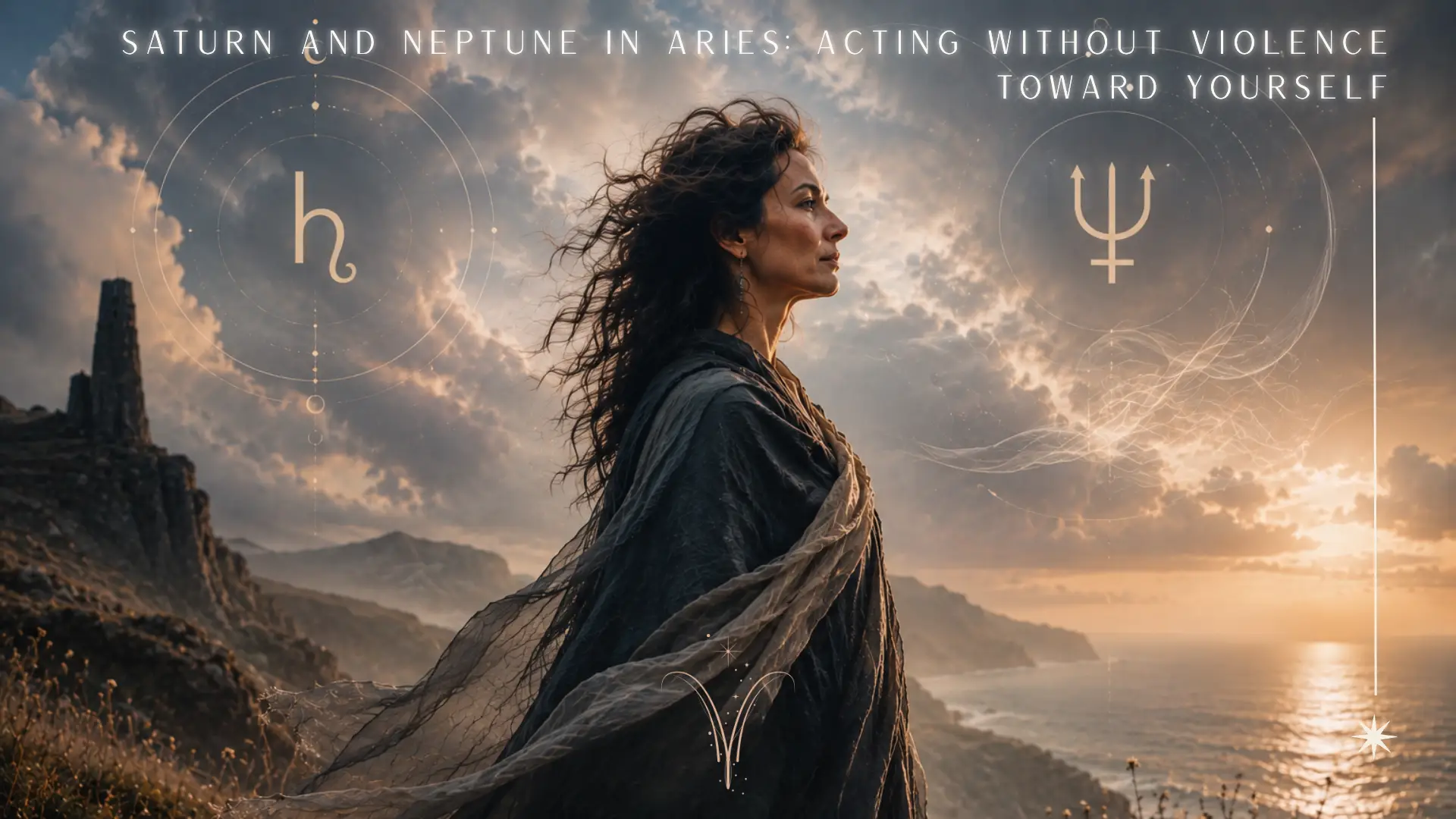
This is where the current conjunction between Saturn and Neptune in Aries becomes symbolically meaningful. Not as a promise of spectacular predictions, but as an image of a deeper collective tension: how do we recover our capacity to act without reproducing old forms of inner mistreatment?
Saturn and Neptune in Aries: A Tension of Our Time
The current meeting between Saturn and Neptune in Aries seems to resonate deeply with this question. Not because it predicts precise events or foreseeable upheavals, but because it offers a particularly compelling symbolic image of the psychological climate we are collectively moving through.
Aries has traditionally been associated with impulse, self-assertion, beginnings, and the courage to act. In its rawest expressions, it speaks to survival instinct, willpower, confrontation, and at times combat itself. Saturn, meanwhile, introduces themes of responsibility, reality, and embodiment.
Neptune’s role appears more diffuse, yet no less essential. For several years now, many people have experienced a growing disillusionment with the models of success and strength upon which our societies have largely been built. Certain forms of hardness once celebrated — relentless self-optimization, hyper-control, the ability to keep going at all costs — are gradually losing their inner legitimacy.
What was once perceived as maturity, discipline, or courage can now feel more like a form of disconnection from oneself. Many people experience a fatigue that goes beyond simple lack of rest; it reflects a growing difficulty in continuing to psychologically adhere to demands that have become increasingly unlivable.
I have explored elsewhere the way certain periods of crisis or disorientation can reveal a deeper misalignment between the life we are living and what is trying to emerge within us. But what strikes me today is the way so many women continue responding to this tension with even greater harshness toward themselves.
From this perspective, Neptune does not so much remove the need for action as gradually dissolve the heroic myths upon which our way of acting has long been built. The conjunction between Saturn and Neptune in Aries creates a very particular tension: that of a time that still pushes us toward self-assertion and engagement while simultaneously questioning the forms of inner violence once considered necessary for transformation.
When Courage Stops Being a War Against Yourself
For a long time, our ideas about courage were shaped around heroic figures who embodied the ability to endure, conquer, withstand, or surpass their own limits. Strength was associated with endurance, self-mastery, and sometimes even a certain form of emotional numbness. To keep going despite exhaustion, to continue despite suffering, or to silence one’s vulnerability could all be seen as signs of maturity and worth.
These models have profoundly shaped the way we inhabit the world, including within spaces supposedly devoted to healing, consciousness, or personal transformation. The capacity to “work on oneself,” optimize one’s life, overcome one’s fears, or fully embody oneself can sometimes become yet another way of placing ourselves under pressure. Even the language of freedom or empowerment can reproduce very old patterns of performance and inner hardness.
I believe this is precisely where something is beginning to shift.
Because the meeting between Saturn and Neptune in Aries does not merely question our capacity to act; it also challenges the way we define strength itself. The old myth of the warrior — the one who advances by cutting himself off from sensitivity, limits, or the need for connection — seems to be gradually losing its symbolic power.
Another figure appears to be emerging, though perhaps more difficult to recognize because it aligns less easily with the models of success our societies reward. A figure capable of acting without turning her own body into a battlefield. A way of moving forward no longer rooted in the denial of vulnerability, but in a more conscious relationship to life itself.
I was deeply moved recently by a phrase from astrologer Rob Brezsny regarding this conjunction: “warriors who fight not to win but to learn how to remain in love with life.”
This image feels profoundly different from the heroic ideals we are accustomed to. It speaks neither of conquest nor domination, but of the ability to remain connected to something alive within oneself, even in a world marked by uncertainty, exhaustion, and disillusionment.
Perhaps this is another form of courage. Not the kind that hardens itself in order to survive, but the kind that allows us to act without abandoning ourselves in the process.
A Different Relationship to Action
Perhaps the real challenge of this period is not learning how to act more, but learning how to act differently.
For a long time, we have evolved within models where action was associated with tension, control, or self-overcoming. Many people learned to see their own exhaustion as an obstacle to conquer, their sensitivity as a weakness to correct, or their need for rest as a form of failure.
Yet something today seems to be searching for another path — a way of moving forward that is no longer based on permanent opposition to oneself.
This does not mean abandoning discipline, commitment, or responsibility altogether. Nor does it mean replacing effort with passivity or avoidance. But perhaps it means gradually stepping outside a logic in which all transformation must necessarily pass through inner coercion, guilt, or war against oneself.
From this perspective, courage may take on a quieter and less spectacular form. It may consist in recognizing one’s limits before collapse, accepting the need to slow down when the body asks for it, letting go of identities built around performance, or acting without waiting to feel perfectly ready.
It may be that this is also what the meeting between Saturn and Neptune in Aries is asking us to contemplate: the possibility of a strength capable of remaining connected to life rather than building itself against it.
We may be moving through a time in which old models of strength are slowly losing their self-evidence. Not because the world requires less courage, but because certain forms of inner hardness seem increasingly incompatible with the longing for meaning, presence, and aliveness that is trying to emerge.
In this context, the meeting between Saturn and Neptune in Aries may invite us less to become more perfected versions of ourselves than to question the ways we have learned to act, struggle, and construct our identities.
I’m wondering if true courage no longer lies in our ability to hold ourselves together against ourselves, but in our capacity to remain connected to something alive within us, even as old certainties begin to crack.
And maybe it is precisely during these periods of transition that astrology becomes most meaningful: not as a tool of prediction or control, but as a symbolic language capable of bringing meaning to inner movements, tensions, and passages of life. This is also the spirit in which I approach natal chart readings — as spaces for reflection and understanding around the dynamics seeking to emerge at a particular moment in a person’s life.