
← Espace de réflexion
- Uncategorized
- 23/10/2026
Full Moon in Taurus October 2026
26th of October 2026
The Bridge Between What Remains and What Is Yet to Come.

- Nathalie Auvolat
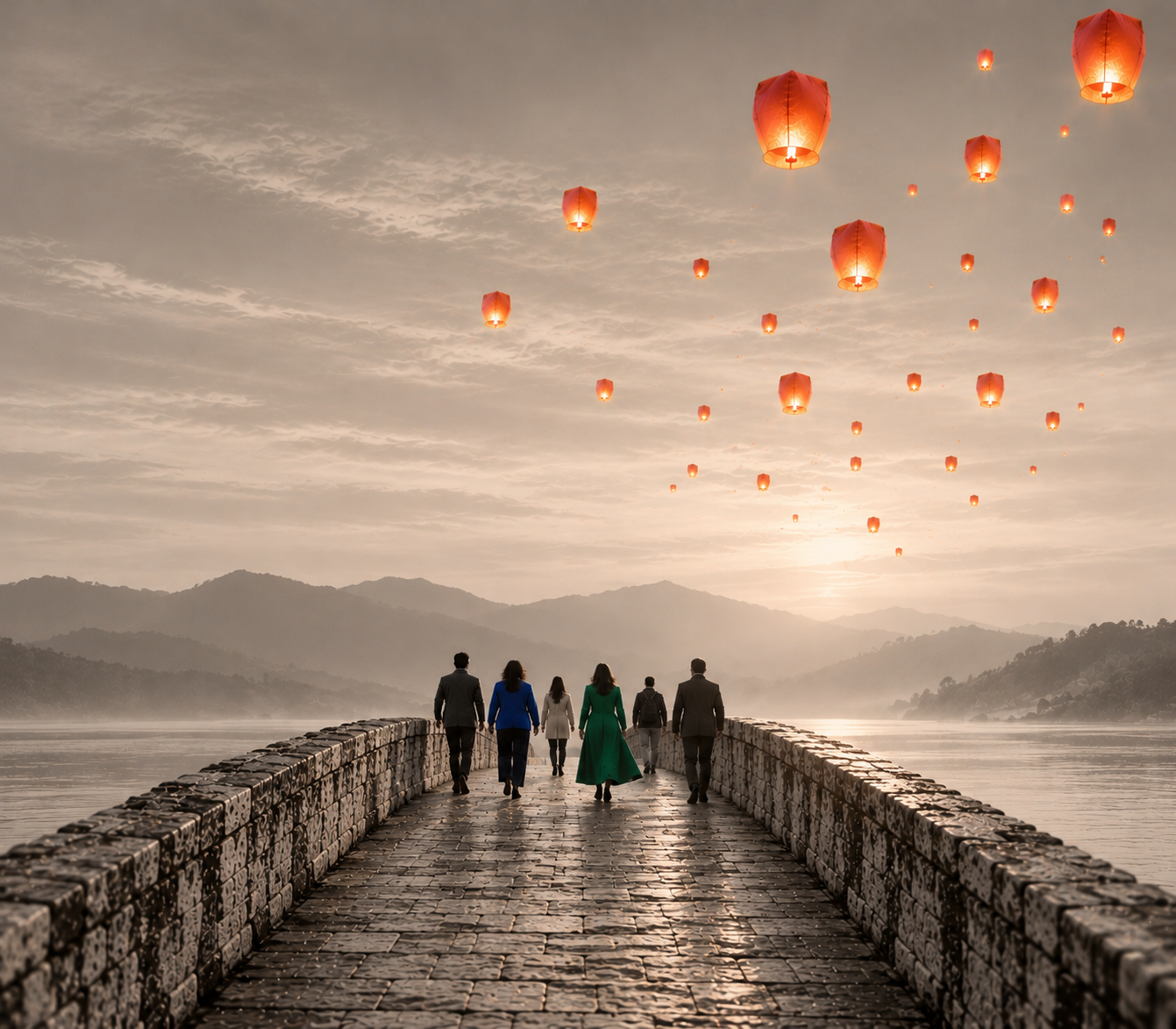
We want to see the world change. We speak out against injustice, question the systems that govern our lives, and imagine different ways of living together. Yet when those changes begin to unsettle the foundations of our own lives, our desire for transformation can meet with an unexpected resistance.
This contradiction deserves closer attention. We do not necessarily resist change because we are unwilling to grow. What we seek to preserve may involve fundamental needs: security, dignity, belonging, and the possibility of building a life stable enough to imagine a future. Nor are these needs confined to our inner world. They depend on material circumstances, political decisions, and collective structures over which we do not all have the same degree of influence.
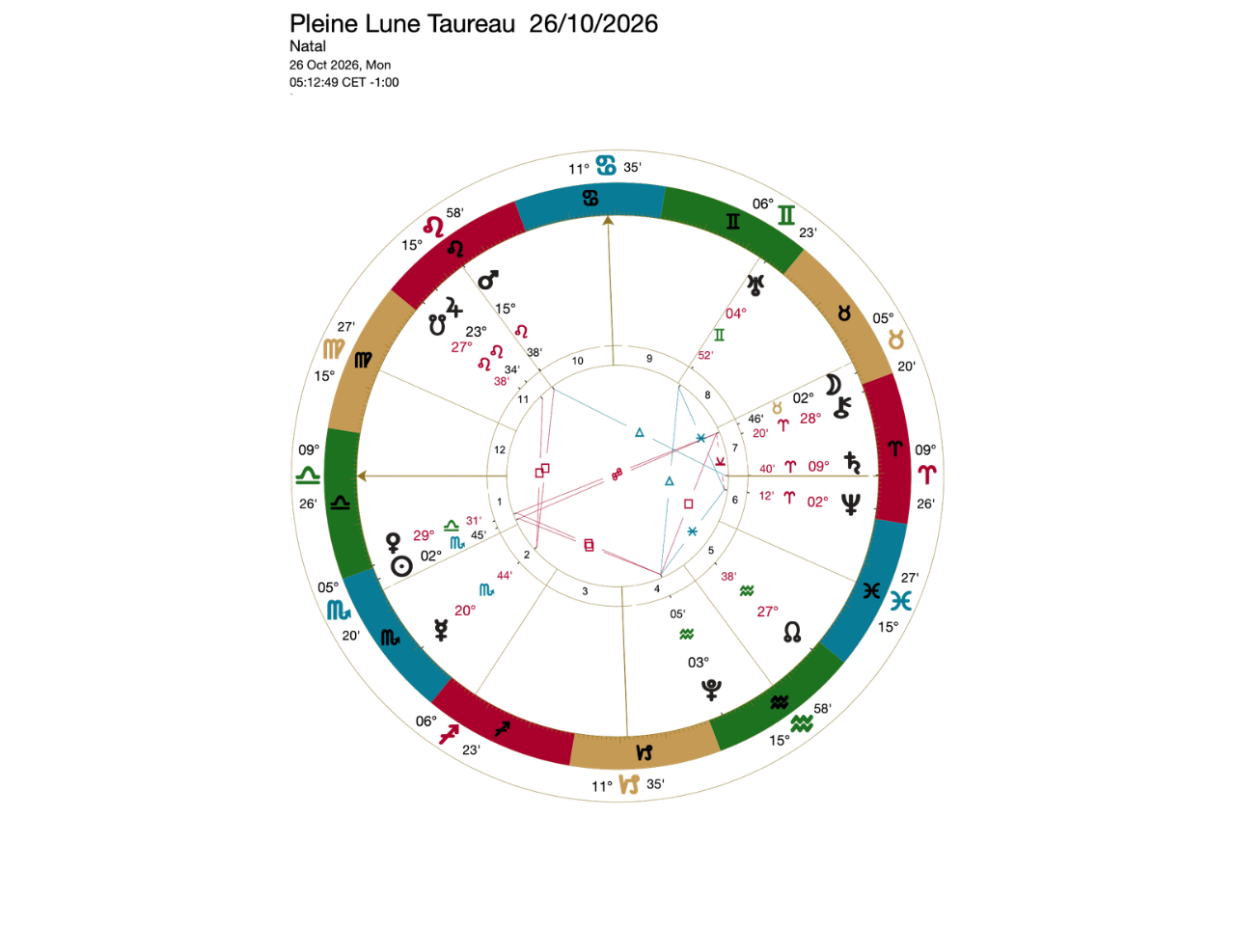
The Full Moon of October 26, 2026, across the Taurus–Scorpio axis, invites us to explore this tension. With Pluto in Aquarius at the apex of a T-square involving both luminaries, it symbolically connects our most intimate attachments with the transformations unfolding across society.
What happens when our desire for change collides with our need for security? The Full Moon in Taurus on October 26, 2026, brings this tension into focus through a T-square with Pluto in Aquarius. An exploration of personal attachments, collective transformation, and the challenge of facing an uncertain future without losing our connection to one another.
I. What We Seek to Preserve
The Moon in Taurus brings us back to a fundamental dimension of human experience: the need for security. Having resources we can rely on, living in a reasonably stable environment, and finding familiar points of reference in everyday life can spare us from having to exist in a constant state of uncertainty. There is nothing inherently weak about this desire. Often, it provides the very foundation from which we can commit ourselves, build something lasting, and make plans for the future.
Opposite the Moon, the Sun in Scorpio confronts us with a less comfortable reality: what has sustained us for years can also become what holds us in place. Certain attachments persist even when circumstances have changed. Habits, loyalties, and established forms of power may continue to shape our lives long after we have begun to recognise their limitations.
The opposition between the two luminaries does not ask us to choose between stability and transformation. Instead, it reveals how difficult it can be to distinguish what deserves to be preserved from what needs to be fundamentally reconsidered. Not every change represents progress, and not every form of resistance amounts to a refusal to evolve.
This tension acquires another dimension through Pluto in Aquarius, which forms a square to both the Sun and the Moon. All three occupy fixed signs, whose capacity to sustain a course of action can, when positions become entrenched, make it harder to consider other possibilities.
Pluto brings into focus collective structures, power relations, and profound shifts that extend far beyond our individual lives. Our need for security never develops independently of the world we inhabit. It is shaped by social arrangements, economic models, institutions, and inherited ways of thinking that we also, in different ways, help to sustain.
Resistance to change, then, cannot be understood solely as an inner psychological mechanism. It may also express the need to defend living conditions that are under threat. Yet recognising the legitimacy of such resistance does not exempt us from examining our own contradictions. Some of our beliefs, affiliations, or habits may contribute to perpetuating the very systems we otherwise challenge. Our participation is not always conscious, nor is responsibility shared equally, but acknowledging these complexities is essential to understanding how societies change.
How can we recognise what holds us back, individually and collectively, without allowing our fears alone to determine what becomes possible?
II. Depth as a Way Through
At the apex of the T-square, Pluto concentrates the tension between the two luminaries. Yet its position in this Full Moon has a remarkable feature: it also participates in a second, more flowing configuration, forming a trine to Uranus in Gemini and a sextile to Neptune in Aries. Together, these three transpersonal planets form a minor grand trine.
This dual involvement is worth considering. On one hand, Pluto confronts us with resistance, defensive mechanisms, power dynamics, and attachments whose influence we may not fully recognise. On the other, it participates in a symbolic pattern that opens perspectives beyond our immediate concerns.
Depth can therefore be understood not as a retreat into ourselves, but as a way of moving between intimate experience and the wider transformations taking place in the world. Exploring the forces that shape us from within may help us recognise the assumptions, loyalties, and habits through which we participate in collective systems. Such awareness is not enough, by itself, to change existing structures. It may, however, change how we engage with them.
Uranus in Gemini introduces the possibility of renewing the way we think. However familiar our interpretations of reality may feel, they are not the only ones available to us. New connections can emerge, different stories can be heard, and convictions once considered beyond question can become subjects of inquiry. Yet intellectual freedom is only meaningful when it includes a willingness to examine our own beliefs, rather than merely exchanging one certainty for another.
Neptune in Aries opens another dimension. Where Aries asserts individual existence through the words “I am,” Neptune may expand that experience towards an awareness of something beyond the boundaries of the individual self. For some, this may evoke a spiritual or sacred dimension. For others, it may suggest a form of trust in life, in the bonds connecting us, or in possibilities that have not yet taken shape. The invitation is not to surrender our individuality, but to stop treating it as the sole measure of reality.
Perhaps this is where the relationship between fear and faith takes on particular significance. Faith, understood here as a form of trust that accepts the limits of our control, does not eliminate anxiety or the need for discernment. It can coexist with a clear-eyed awareness of the world’s difficulties, without requiring us to know in advance how its transformations will unfold. It also carries risks: idealisation, avoidance of reality, or allegiance to promises that relieve us of the responsibility to think critically.
The harmonious aspects linking Uranus, Neptune, and Pluto therefore offer no guarantee of a favourable outcome. Rather, they suggest a possibility: bringing together the work of examining what lies beneath the surface, the renewal of our perspectives, and an openness to what exceeds our individual will. This does not free us from the contradictions of our time, but it may allow us to move through them differently.
III. Beyond Agreement
Venus plays a quiet but significant role in this Full Moon. As ruler of the Moon in Taurus, she is positioned in the final degrees of Libra, a sign she rules, revisiting relational questions that have already emerged during her retrograde journey. Following her passage through Scorpio, where attachments, desires, and power dynamics may have come under scrutiny, her return to Libra invites us to reconsider the foundations of our relationships and the values we wish to uphold within them.
This question becomes especially relevant when disagreements harden into divisions. The fear of losing familiar ground, the feeling that our identity is under threat, or the conviction that we are defending a just cause can gradually diminish our ability to recognise the reality of another person. Instead of encountering someone in their full humanity, we begin to see only a position, an affiliation, or an opinion we oppose.
Yet remaining in relationship does not mean seeking agreement at any cost. Some confrontations are necessary, certain boundaries must be upheld, and some situations demand more than a willingness to engage in dialogue. Recognising the humanity of those whose views differ from ours does not require us to erase differences or accept unjust power relations. It asks us, rather, not to confuse the strength of our convictions with a need to dehumanise those who do not share them.
Perhaps our relationship with change can also be measured by this capacity. It is relatively easy to imagine a different society when we are the ones defining its contours. It is considerably more demanding to accept that such a transformation will have to be shaped alongside people whose experiences, needs, and aspirations do not always coincide with our own.
The Full Moon of October 26 does not tell us what tomorrow’s world will look like. It illuminates the tension between what we wish to preserve and what we sense must evolve, while suggesting the possibility of a more attentive awareness of our inner patterns, our interdependence, and what lies beyond our certainties.
We will not all move through these changes in the same way, or with the same resources. Nor is there any guarantee that our paths will converge. But the question remains: can we make room for the unknown without abandoning what connects us to one another?
Continue exploring.
Every birth chart tells a unique story about how we inhabit the world.
RÉSONANCES
À lire
Nom de l’auteur
Nom de l’ouvrage
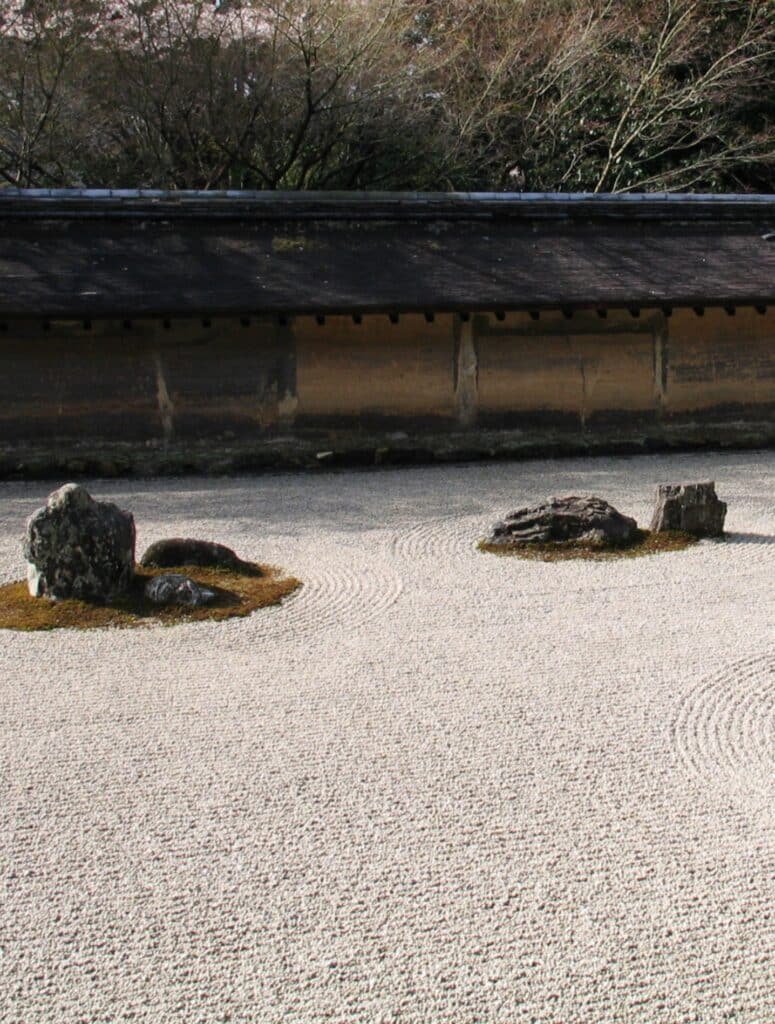
À contempler
Nom de l’oeuvre ou du lieu
Nom de l’ouvrage
More paths for reflection.
- All Posts
- Astrology & Symbolic Perspectives
- Life Transitions & Passages
- Psyche & Inner Life
- Uncategorized

The reflection continues with you.


© 2026 Alkymissia — All rights reserved.