Cycles and Transitions

This category gathers reflections on cycles of time and the moments of transition that shape the unfolding of life.

New moons, full moons, astrological transits and seasonal shifts are explored as lived experiences at the meeting point between the sky and human experience.

These cycles are approached as symbolic rhythms that accompany periods of transition and inner transformation.

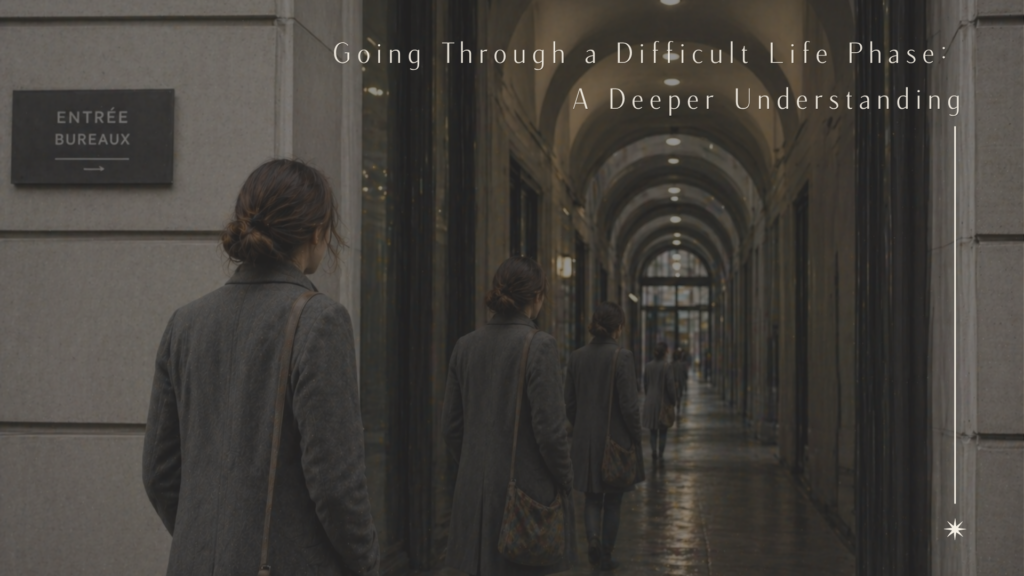
going through a difficult life phase, woman walking alone in a symbolic passage
Cycles and Transitions

Going Through a Difficult Life Phase: A Deeper Understanding

Going through a difficult life phase is not always obvious at first. Nothing is collapsing entirely, and yet something no longer holds together in quite the same way. A subtle sense of dissonance begins to appear. Decisions require more effort, certain situations feel unexpectedly heavy, and a diffuse fatigue may arise without any clear reason. In these moments, it is not uncommon to carry on as if nothing were happening. To maintain commitments, keep moving in the same direction, make small adjustments, and find ways to hold things together just a little longer. As if not stopping could prevent something from emerging. And yet, something insists. A quiet but persistent feeling that something is not right. A sense that what is being lived cannot simply be resolved by doing more, doing differently, or doing better. But as long as it cannot be fully acknowledged, it remains in the background, like a silent tension. When going through a difficult life phase, continuing can become a way of avoiding There are times when you feel on the edge of something, without actually changing what is leading you there. A certain fatigue settles in, sometimes accompanied by a sense of saturation or exhaustion, and yet the same responses keep being repeated. Organising more, pushing a bit further, finding strategies to make it pass. From the outside, everything may seem under control. Solutions exist, efforts are being made. But inwardly, another reality may be unfolding: one that is not asking to be compensated, but to be recognised. In these moments, continuing to act can become a way of not stopping. Not out of a lack of awareness, but because stopping would mean facing something that is not yet ready to be fully received. What is really happening when you are going through a difficult life phase What emerges in these phases is not simply a temporary imbalance. It is not just a matter of overload or an isolated difficulty, but a deeper shift that affects the way you are engaged in your life. A direction that no longer fully resonates. A way of functioning that has held for a long time but is beginning to reach its limits. A form of loyalty that can no longer be maintained in the same way. At this stage, surface adjustments are no longer enough. Something is asking to move at a deeper level, even if it cannot yet be clearly articulated. Why certain patterns repeat during a difficult life phase When this movement cannot be consciously recognised, it does not disappear. It continues to act. It returns, sometimes in different forms, in different contexts, but with a similar tone. The same fatigue, the same tension, the same difficulty in setting a boundary or changing direction. Each situation seems to have its own explanation. And yet, something persists, as if the same question were trying to emerge without yet finding its answer. What is avoided does not vanish. It shifts. And as long as it cannot be consciously received, it returns—often with increasing intensity—as if trying to become visible despite resistance. This is not mechanical repetition. It is a form of regulation, a process that has not yet found its point of integration. There comes a moment when what could still be bypassed can no longer be avoided. Not because a solution suddenly appears, but because the tension becomes too strong to remain in the background. What needed to be seen can no longer be ignored in the same way. Understanding a difficult life phase within a larger life transition When going through a difficult life phase, it can be tempting to reduce what is happening to an isolated difficulty that needs to be managed or resolved. Yet this perspective often leaves a sense of incompleteness, as if something essential were missing. Considering that these phases are part of a larger movement allows for a subtle shift in perspective. Not to diminish their intensity, but to recognise that they belong to a process that goes beyond the situation itself. This is where astrology can offer a meaningful framework. Not as a predictive tool, but as a symbolic language that helps place these experiences into perspective. In some cases, this perspective is part of a broader transformation process, which I explore further in my article on astrology and personal transformation. It offers a way of understanding time that goes beyond a simple sequence of events. A way that recognises cycles, phases of transformation, and moments when existing structures reach their limits and need to be reorganised. This perspective does not resolve the tension, but it allows it to be held differently. What seemed chaotic can begin to reveal itself as a transitional phase within a larger dynamic. Finding your place while going through a difficult life phase When you are going through a difficult life phase, the natural tendency is often to accelerate. To regain stability quickly, to understand in order to act, to move out of discomfort. But not all movements can be rushed. Some transformations require a time that cannot be reduced. Trying to move too quickly may simply recreate, in another form, what is already reaching its limit. To situate yourself within this movement is not about doing nothing, nor about waiting passively. It is about developing a finer attention to what is unfolding. Recognising what insists, without immediately trying to make it disappear. Allowing part of the process to remain, for a time, incomplete. Accepting that some answers are not yet accessible. This position is not comfortable. But it is often within this space that something reorganises itself at a deeper level. Going through a difficult life phase is not simply a matter of correcting an imbalance. What is unfolding here cannot always be immediately understood, nor resolved through familiar reference points. What insists, what returns, what can no longer be avoided is often part of a deeper movement that needs to be recognised before it can transform. Astrology, when approached as a symbolic

Going Through a Difficult Life Phase: A Deeper Understanding Read Post »
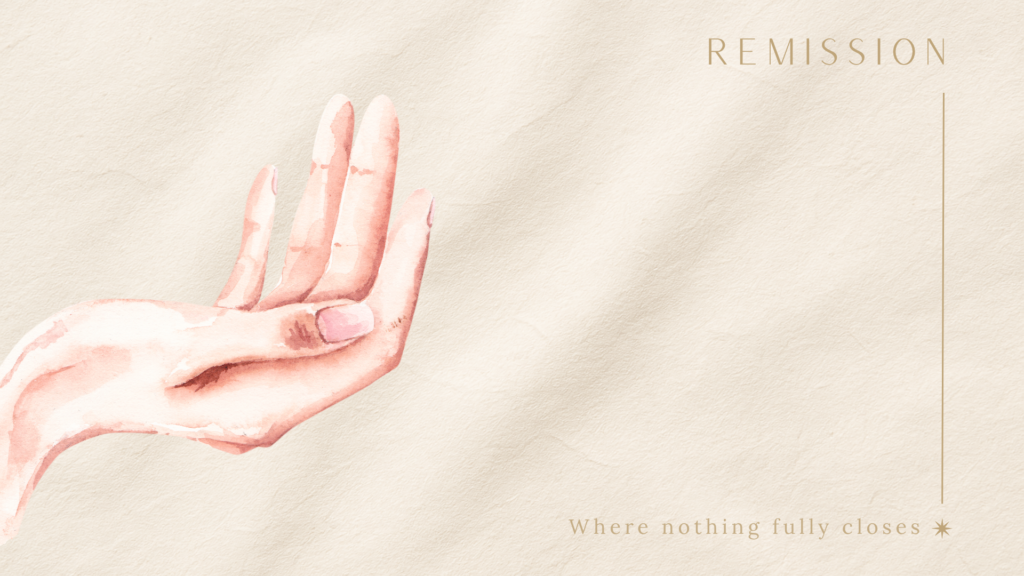
open hand symbolizing remission after cancer and inner release
Cycles and Transitions

“Remission” after cancer: what this word doesn’t say

This morning, at the lab where I went for a follow-up blood test, the nurse who was taking care of me — and who had probably read my file — asked where I was in my health journey. The conversation unfolded simply, almost naturally, as it sometimes does in these places where lives briefly intersect. At one point, he used a word that often comes up when talking about cancer: remission. It is a word I now hear regularly in medical settings. A word that, on the surface, should bring relief, since it means that the disease is no longer detectable and that the treatments have worked. And yet, each time I hear it, something resists. A part of me almost immediately feels the need to correct it, as if the term failed to fully translate what has been lived. I find myself thinking, inwardly: “No, I am not in remission. I am healed.” On my way home, this reaction stayed with me. Why do we speak of remission when it comes to cancer, while for most other illnesses we simply speak of healing? And more importantly, what does this word do to those who hear it — and who must then continue to live with it, sometimes for years? This questioning led me to realise that remission does not only describe a medical state. It also shapes a particular relationship to time, as if life after illness were placed in an in-between space — neither entirely what it was before, nor completely free from what has been lived through. A named horizon In the course of cancer, certain words take on a particular place — almost silent, yet deeply charged. They circulate in medical exchanges, in conversations with loved ones, and in thoughts we do not always dare to express. Among them, the word “remission” holds a singular position. It appears as a kind of horizon, a point toward which everything seems to move, even when its exact meaning, for me, remains unclear. Over time — through treatments, tests and appointments — life gradually reorganises itself around a single focus: moving out of illness. Not necessarily in a theoretical or strictly medical sense, but in a very concrete experience of returning to a form of normality. Being able to make plans without suspending them on results, no longer living according to medical protocols, and rediscovering a body that is not only perceived through the lens of monitoring. In this context, the word “remission” settles in as an implicit promise. It does not always clearly say what it means, yet it carries the idea of a passage. As if it marked the moment when something closes, when illness recedes from the foreground, and when everyday life might begin to unfold more gently again. There is, within this expectation, a form of shared evidence: the idea of a before and an after, separated by a line we imagine to be clear. And yet, more quietly, a transformation is already at work. Moving through illness does not leave a person untouched. Even as one projects forward — toward an exit, toward a return to life — there can be a more diffuse perception: that this “after” will not simply be a continuation of what was. The paradox of remission This is where a shift begins to take place. If the word “remission” is meant to mark a way out of illness, it does not, in reality, create the feeling of a clear transition. It does not close the experience. It does not draw a distinct boundary between a before and an after. On the contrary, it introduces a state that is harder to grasp. An in-between space, where the illness is no longer visible, yet not entirely consigned to the past. As if the body had changed status, without life fully recovering its previous continuity. Silently, this word brings with it a particular relationship to time. A time that does not fully close. The parenthesis of illness is no longer open in the same way, yet it has not closed either. It remains there, in the background, like a trace that does not entirely fade. Life goes on, of course. One walks, works, laughs, makes plans. And yet, within the very structure of time, a shift has taken place. There is no longer that sense of an obvious return to what once was. And perhaps this is the true paradox of remission: it signals an exit, yet it does not carry the feeling of an ending. Why medicine uses the word “remission” If this word can feel unsettling on an inner level, it is not used at random. It belongs to a precise language — that of medicine — which does not aim to translate lived experience, but to describe an observable state. To say that someone is in remission means that the visible signs of the disease have disappeared, that the treatments have worked, without asserting that the illness has definitively gone. In this context, the intention is neither to minimise what has been lived through, nor to maintain a sense of worry, but to remain as close as possible to what can be objectively observed. The body, despite everything we understand about it today, remains in part unpredictable. Medicine proceeds with that limitation. And this is perhaps where a form of inner tension arises. Because hearing this word can be frustrating. Not because it is inaccurate, but because it does not fully acknowledge what has been lived. It does not symbolically close the experience. It does not allow one to fully say: it is over. And yet, at the same time, it carries a deeper form of coherence. In its own way, it reminds us that no absolute certainty is possible. That life, as a whole, escapes any definitive guarantee. What cancer makes visible, with particular intensity — this uncertainty, this impossibility of total control — in fact belongs to the human condition itself. Perhaps this is also why

“Remission” after cancer: what this word doesn’t say Read Post »

Saturn in astrology and the slow construction of a vocation through a birth chart reading
Cycles and Transitions

Saturn and the Making of a Vocation

You have probably already heard this kind of story. The story of someone who seemed to know very early on what they were meant to do. Sometimes we hear: “She always knew she would become a singer.” Or: “As a child, she spent hours drawing, singing, fixing things, or watching the sky.” From the very first years of her life, a direction already seemed to be taking shape. These stories often appear in biographies, interviews, or portraits of public figures. They suggest an almost perfect continuity between childhood and adulthood, as if some lives were following a thread that had already been laid out. There is something reassuring about such narratives. We may even find ourselves envying them. They create the impression that certain lives are guided by an inner certainty, an early coherence that shapes choices and commitments long before the person becomes fully aware of it. And yet, when we look around us, this kind of trajectory remains relatively rare. Many lives do not begin with a clear sense of certainty. They unfold through successive experiences, often far removed from one another, sometimes even chaotic, without a clear direction emerging right away. Less obvious paths In many lives, things do not immediately take the form of a clear direction. Years unfold through choices sometimes shaped by circumstances, by the influence of others, or by family history. One accepts a job simply because it allows one to live. One pursues a course of study because it seems accessible. One responds to an opportunity without knowing exactly where it might lead. At the time, these decisions may appear to belong to entirely different realms, forming no obvious coherence. From the outside, such paths can look hesitant. The stages may appear discontinuous, even contradictory. Yet with hindsight, these experiences sometimes begin to respond to one another. Certain skills develop almost without our noticing. A particular sensitivity gradually takes shape through repeated situations. What once seemed scattered may slowly reveal an underlying continuity. Yet this movement often remains invisible while it is happening. It takes time for a direction to become recognisable. What the years quietly shape With time, some experiences begin to take on a different meaning. What once appeared scattered may look quite different when we turn back and look again. At times we may even feel a sense of nostalgia as we observe the path we have travelled. Responsibilities carried over many years, a skill developed almost in spite of oneself, a sensitivity that deepens through repeated situations. Gradually, something takes shape through accumulated experience. This process is rarely spectacular. It does not resemble a sudden revelation. Rather, it emerges from the way the years confront us with reality: what resists, what requires perseverance, what compels us to develop resources we did not always know we possessed. Only with hindsight do certain elements begin to connect. Experiences that once seemed unrelated may reveal an unexpected continuity. Astrology, when approached as a symbolic language of human experience, also offers a way of thinking about this relationship between time and the shaping of a life. The position of Saturn in a birth chart may then appear as a particularly revealing point: a territory where experience, over the years, suddenly begins to make sense. This question of meaning gradually emerging within a life trajectory also echoes a reflection I explore in another article devoted to the Sun–Moon axis and the way our inner dynamics shape our choices over time. Saturn and vocation in astrology In an astrological chart, the planet Saturn is often associated with time, experience, and what is built slowly. Where some dimensions of a life unfold with relative ease, others require patience. It may concern an area where things do not move forward as quickly as one might have imagined. Situations demand adjustments, perseverance, and sometimes even a renunciation of certain initial expectations. This gradual confrontation with reality is not a symbolic punishment. It corresponds rather to a process of maturation. The obstacles, responsibilities, and demands encountered over the course of life require us to develop particular resources. Over time, these experiences can profoundly transform the relationship we have with the part of the chart where Saturn is located. What first appeared as a constraint may become an opportunity for more conscious engagement, even a path toward deeper self-reflection. This is why Saturn often plays a role in the progressive (re)construction of a life path, through experience, determination, and confrontation with reality. In some cases, this placement in the chart takes on particular significance in the way a person may come to embody what is sometimes called their “life purpose.” What a time of introspection reveals When certain life paths are recounted afterwards, they often take the form of a simple narrative. Childhood already seems to contain the signs of what was to come. Hesitations disappear, detours blend into an almost natural continuity. But lived reality is rarely so linear. It is composed instead of accumulated experiences, sometimes unexpected circumstances, and decisions made without always grasping their full significance. Only with hindsight do certain lines become visible. What once appeared scattered may then reveal a coherence that nothing seemed to suggest at the beginning. Perhaps this is also what Saturn’s symbolism reminds us: that certain dimensions of a life can only be understood through time and through the trials we encounter. And for those who wish to explore more deeply how these dynamics appear within a birth chart, an astrological reading can sometimes offer valuable insight.

Saturn and the Making of a Vocation Read Post »

Scroll to Top