
We often think that periods of transition ask us, above all, to change. To rethink our habits, redirect our choices, question our certainties, or sometimes even set out on entirely new paths.
Yet when change stretches over time and uncertainty becomes part of everyday life, another challenge quietly emerges—one that is perhaps even deeper.
It is no longer only our ability to adapt that is being tested. It is also our capacity for discernment.
When the familiar landmarks of our lives begin to shift, how do we recognise what is still worth nurturing, protecting or pursuing? And on what basis do we continue to decide what truly matters?
I. Where Do Our Inner Criteria Come From?
Don’t we often feel as though we already know what truly matters to us?
Some decisions seem obvious. Certain choices feel almost inevitable, while others appear simply unthinkable. We move through life guided by an inner compass whose directions we rarely question.
Yet this inner orientation did not emerge on its own.
Our upbringing, family environment, culture, the challenges we have faced, the people who have shaped us, and the wounds to which we have learned to adapt have all contributed to forming the way we perceive the world. From this personal history emerge—often without our awareness—the criteria by which we judge what feels desirable, acceptable, reassuring or, conversely, threatening.
But our personal story is itself part of a much larger one.
We grow up within a particular era, one that passes on its own ideas about success, happiness, security, progress and even the value of a human life. Gradually, these collective narratives become reference points through which we interpret reality, often without realising it.
We rarely question these inner reference points. Not because they are necessarily universal or inherently true, but because, until now, they have allowed us to find our way through life. As long as they continue to make sense of the situations we encounter, we have little reason to examine them. Over time, we become so accustomed to relying on them that we eventually forget they are there at all.
Take something as simple as the way we walk. We pay very little attention to it as long as it allows us to move forward without difficulty. It is usually only when pain, imbalance or an obstacle appears that we suddenly become aware of every single step.
Perhaps the same is true of the way we perceive our environment. As long as it continues to guide us with sufficient accuracy, our inner navigation system remains almost invisible. It is often only when it no longer corresponds to reality that we realise it has quietly been guiding our lives all along.
Perhaps this is precisely what makes periods of transition so significant.
They do not simply ask us to make new decisions. They reveal the foundations from which those decisions arise. What once seemed self-evident gradually loses its certainty. We begin to realise that our way of interpreting reality is neither universal nor timeless. It is the product of a particular history, a particular context and a particular way of inhabiting the world.
Perhaps this is the deepest significance of any transition.
It does not merely transform the external circumstances of our lives. It also invites us to re-examine the foundations that have quietly shaped our choices, often without our ever becoming aware of them.
II. Revisiting the Origins of Our Perception
Periods of transition have a remarkable quality: they make visible the inner reference points we had long ceased to notice.
They also invite us into a different kind of exploration—one that leads us back to the place where those inner reference points were first formed.
This is precisely where the symbolism of Cancer becomes especially meaningful.
We often reduce this sign to family, childhood or emotions. Yet it points to something far more fundamental: the psychological function that builds the inner foundations from which we experience the world.
These foundations do not protect us from life’s upheavals. Rather, they provide the psychological container that allows us to welcome experience, make sense of it and, little by little, develop a genuine sense of inner security.
This New Moon therefore invites us to do far more than revisit our past.
It encourages us to explore the place where our earliest ways of perceiving reality took shape—the ways we learned to seek safety, place our trust, and recognise what felt worthy of preserving.
It brings us back to that often invisible ground from which, even today, we continue to interpret what happens to us.
The presence of Mercury retrograde, closely aligned with this New Moon, reinforces this invitation.
Rather than searching for entirely new answers, we are encouraged to allow old questions to return to consciousness. Before changing our choices, we may first need to understand how those choices came into being.
III. What Now Calls for Our Awareness
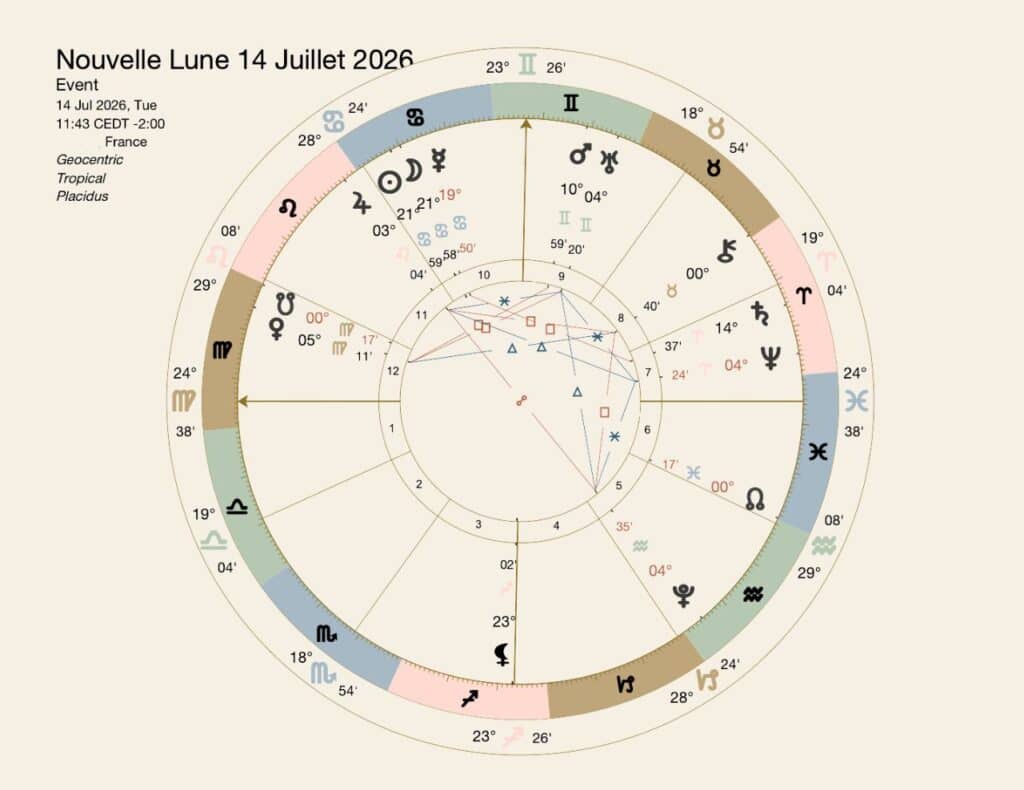
The chart of this New Moon offers a particularly meaningful perspective.
At the heart of its dynamics lies a T-square, with Chiron acting as its focal point. In astrology, Chiron does not simply represent a wound. More often, it points to an area of tension that invites us to examine how we integrate our experiences rather than trying to avoid them.
In this configuration, Chiron is in Taurus, symbolically referring us to Venus, the ruler of the sign. This detail is especially significant because it subtly shifts the focus of our reflection.
Rather than asking simply what decisions should I make?, we are invited to ask a deeper question:
What values shape those decisions?
On what basis do we judge that a particular direction is worth pursuing? What leads us to believe that one choice is right, that a relationship deserves to be preserved, or that a project is truly worth our commitment?
Taurus naturally brings us back to the notion of value. Not only what we possess or seek to preserve, but also the foundations upon which we build our sense of stability.
It encourages us to examine the inner reference points through which we evaluate our lives and assign greater importance to certain experiences than to others.
The conjunction of Venus with the South Node adds another important layer of meaning.
The South Node speaks of what is familiar: ways of thinking, acting and evaluating that have guided us for a long time. They are not necessarily mistaken. Quite the opposite—they have often been valuable resources.
Yet this configuration suggests that these familiar patterns may no longer be sufficient to meet the profound changes we are currently experiencing. They now ask to be reconsidered.
Part of the answer, perhaps, lies with the North Node.
From this perspective, discernment takes on an entirely new meaning.
It is no longer simply about choosing between different possibilities. It becomes an invitation to question the inner values from which we attribute meaning to people, situations and the paths we choose to follow.
Perhaps what is now asking to evolve is not merely the decisions we make, but the very foundations upon which we determine what is worth nurturing, protecting—or leaving behind.
IV. A Time That Calls Us to Rethink Our Bearings
If this New Moon invites us to return to our inner foundations, it is probably no coincidence.
It unfolds at a time when transformation extends far beyond our individual lives. It also affects the collective reference points that have shaped the way we understand the world for generations.
Technological breakthroughs, geopolitical upheavals, ecological crises, profound changes in the world of work and the rapid development of artificial intelligence are not simply transforming our daily lives. They are challenging the very narratives upon which many of our certainties have been built.
What we once called progress, success, security, knowledge—or even the value of a human life—is now being questioned in ways that may prove irreversible.
It is within this broader context that the harmonious aspects linking Uranus, Neptune, Pluto and Jupiter take on their full significance.
Despite the tensions highlighted by the T-square, the chart of this New Moon suggests that another movement is already unfolding.
The profound transformations shaping our era are not only a source of uncertainty. They also offer an extraordinary opportunity to rethink our assumptions, broaden our perspective and imagine new ways of engaging with the world.
Within this configuration, Uranus plays a particularly significant role.
Closely connected to the other transpersonal planets, it appears to support the process of individuation we have explored before—not as an affirmation of the self against the collective, but as the capacity to respond to profound collective change in a deeply personal and authentic way.
Perhaps individuation is not about withdrawing from the world.
Perhaps it is about participating in it without losing the unique perspective that is ours alone.
From this perspective, the question raised by this New Moon reaches far beyond our personal story.
It invites us to ask which ideas and assumptions continue to guide our choices.
Which still arise from a living experience?
And which belong instead to collective narratives that we continue to reproduce without ever truly questioning them?
Perhaps this is one of the greatest invitations offered by this lunation: to learn to distinguish what deserves to be preserved from what is now asking to be transformed.
Not for the sake of change itself, but because some of the ways we once inhabited the world no longer correspond to the reality that is emerging.
Further Reading
If this reading resonates with you, you may also enjoy these articles:
- Saturn and the Building of a Vocation — when structure becomes a source of support rather than limitation.
- Astrological Energies for July 2026 — placing this New Moon within the broader astrological landscape of the month.
- Astrology and Personal Transformation — exploring how astrology can accompany life’s major transitions.
Continue the Exploration
Every birth chart tells the story of a unique way of inhabiting the world.
When our familiar reference points begin to shift, the natal chart can become a valuable framework for understanding the values that guide us, the foundations upon which we have built our lives, and the transformations now seeking to emerge.
If this reflection resonates with your own journey, I invite you to discover my Integrative Birth Chart Reading.
Resonances
To Read
Hartmut Rosa – Resonance: A Sociology of Our Relationship to the World
Why this recommendation?
Because it is neither about psychology, astrology nor personal development.
Instead, it asks a question that feels remarkably close to the one explored throughout this article:
What allows a human being to remain truly alive in their relationship with the world?
Hartmut Rosa argues that the greatest challenge of our time is not simply acceleration, but the gradual loss of a living relationship with people, places, work, nature and ideas. We continue to accumulate experiences without always allowing ourselves to be transformed by them.
To me, this beautifully echoes the invitation offered by this New Moon.
For perhaps the deepest question is not simply:
“What has value?”
But rather:
“From what place within ourselves do we continue to recognise what is truly worthy of our commitment?”
To Contemplate
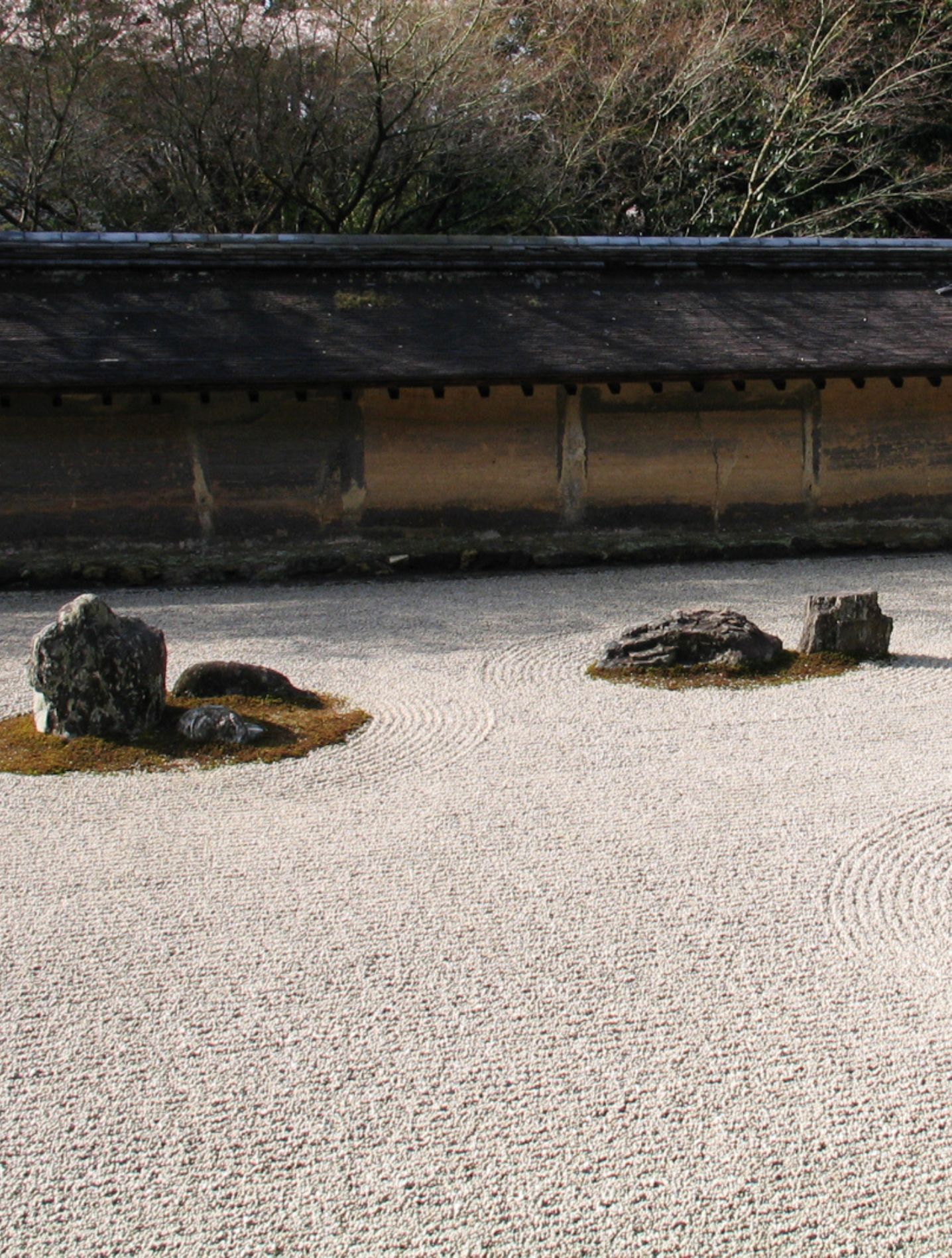
The Zen Rock Garden of Ryōan-ji, Kyoto
ome places do not seek to impress the eye. They seek to educate it. The Zen garden of Ryōan-ji is one of them. At first glance, very little seems to happen. A few carefully placed stones, raked gravel and an abundance of empty space. Yet the longer we remain with it, the more something quietly shifts within us. To me, it offers a beautiful image of discernment. Discernment is perhaps not about gathering more information, but about learning to see differently what has been there all along.
“May you have the wisdom to read time clearly and know when the seed of change will flourish.”
John O’Donohue